

When I first started experimenting with generative AI, I thought I was learning new tools.
First writing. Then virtual singers. Then music.
Each project felt like another step in understanding what creativity would look like in the coming decade.
I was wrong.
Creating War Brides didn’t teach me a new tool.
It taught me an entirely new craft.
From Consumer to Creator

Like many people, I grew up watching films.
Thousands of them.
Good films disappear into the background. We forget they are engineered experiences because everything feels effortless.
Only when attempting to build one from scratch do you realize just how many disciplines are hiding beneath those two hours on screen.
Writing
Photography
Cinematography
Lighting
Acting
Sound design
Editing
Pacing
Color grading
Music
Historical research
Continuity
Production planning
Every single shot is the result of hundreds of decisions.
AI may generate images and video.
It does not make those decisions for you.
Learning to Think Like a Filmmaker
The biggest surprise wasn’t learning software.
It was learning to think differently.
As someone with an engineering and analytics background, I instinctively wanted to optimize everything.
Generate more.
Generate faster.
Fix later.
Film-making punishes that mentality.
Every unnecessary scene costs time.
Every extra location multiplies complexity.
Every wardrobe change introduces continuity challenges.
Every new character expands the production exponentially.
Very quickly I realized that filmmaking is not about generating content.
It is about eliminating unnecessary content.
That was perhaps my first real lesson.
My AI Filmmaking Workflow
Much like when I composed my AI-generated music (which you can read about in my earlier post), ChatGPT became much more than a chatbot throughout this project. It evolved into a research assistant, script editor, historical consultant and, perhaps most importantly, a learning companion as I immersed myself in the craft of filmmaking.
Beyond helping me structure scenes and screenplays, it assisted with adapting dialogue to the dialects and expressions appropriate for 1930s Spain, validating historical details (alongside many hours of traditional research), and exploring different cinematic approaches before I committed valuable generation credits.
One experiment proved particularly successful: I developed a Dialogue Compiler – a custom tool that translated screenplay dialogue into production-ready prompts for AI video generation – specifically designed for my production workflow in Runway.
My primary platform for video generation was Runway, using mainly the Seedance 2.0 and Gen-4.5 models. The platform is evolving at an extraordinary pace and already offers impressive cinematic capabilities. While it is not yet a complete end-to-end filmmaking studio (at least at the time of writing), its Workflow system allows creators to build sophisticated generation pipelines that maintain consistency throughout a project.

Rather than relying solely on Runway’s built-in prompt suggestions, I chose a different approach. Because the screenplay, historical research, character development and production planning already lived inside ChatGPT, it made sense to generate prompts within that same context. This ensured that every shot remained consistent with the narrative, the characters and the visual language established throughout the film.
The Dialogue Compiler became the bridge between screenplay and production. It automatically considered the intended duration of each shot, estimated how much dialogue could realistically fit within that time, assigned speaking roles unambiguously and produced structured prompts optimized for cinematic video generation. In practice, it significantly reduced prompt iteration while improving continuity across scenes.
Music followed a similarly integrated philosophy. Rather than searching for existing tracks, I composed an original soundtrack using Suno, allowing each piece to be tailored to the emotional rhythm of individual scenes instead of forcing the film to adapt to pre-existing music.
Sound effects were created using a combination of ElevenLabs and carefully selected recordings from the Freesound community, providing a balance between AI-generated effects and authentic environmental sounds.
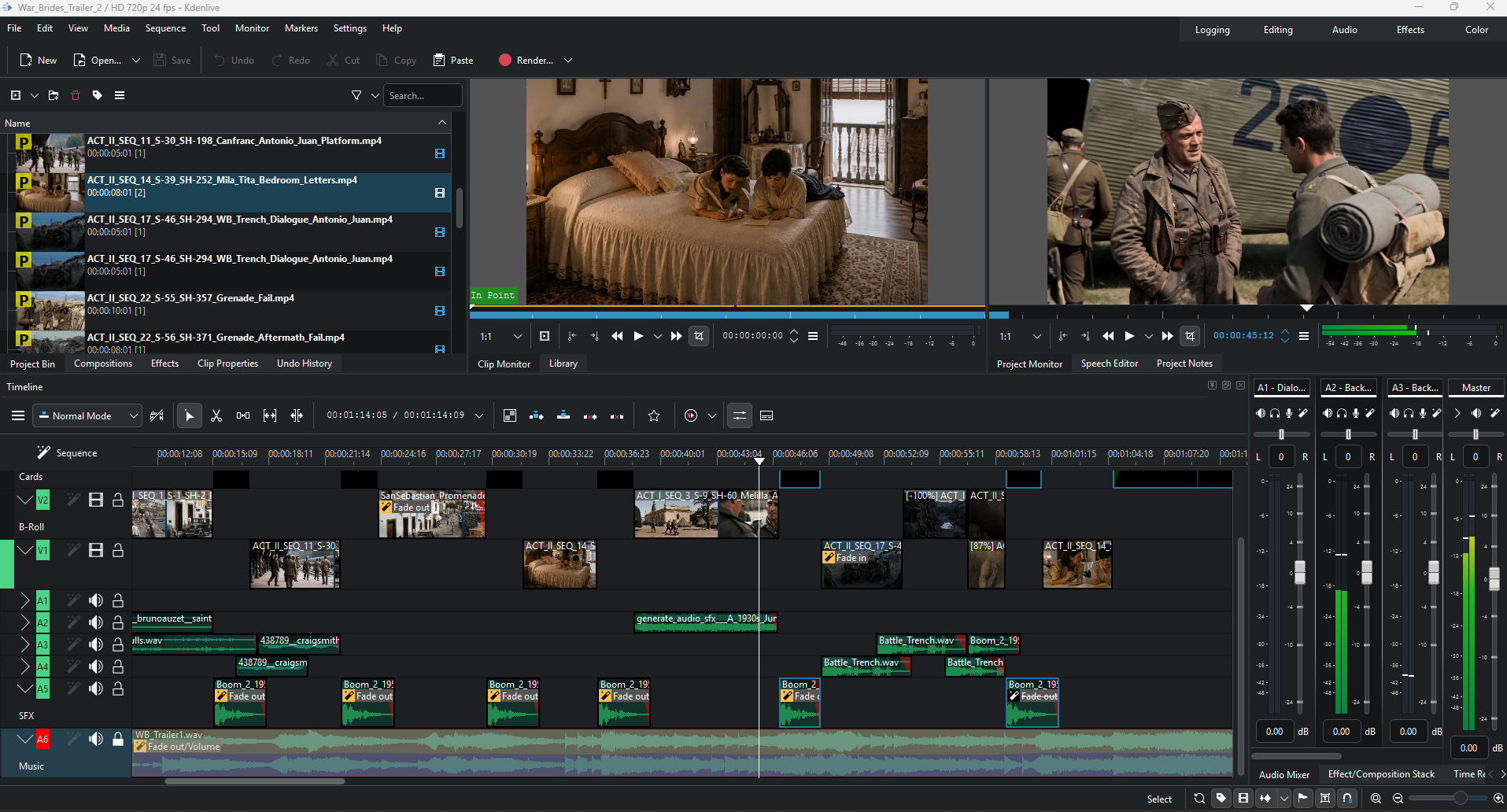
For editing, I deliberately chose Kdenlive during the production phase. Its lightweight workflow allowed me to iterate quickly through hundreds of generated clips without unnecessary overhead. As the project approaches completion, however, I expect the final grading, finishing and rendering to be performed in DaVinci Resolve, whose professional colour grading and finishing tools are better suited to the final stages of production.
Audio editing and cleanup are performed in Audacity, which continues to be one of the simplest and most effective tools for dialogue editing, restoration and mastering.
War Brides Teaser
Perhaps the most surprising discovery throughout this process was that AI did not simplify filmmaking nearly as much as I expected. Instead, it demanded a far more structured production pipeline. Character bibles, location bibles, historical references, naming conventions, storyboards, production spreadsheets and custom workflow tools became just as important as the AI models themselves. The technology generated the images—but organization, consistency and storytelling remained entirely human responsibilities.
The Spreadsheet Nobody Sees
One misconception about AI filmmaking is that it removes planning.
In reality, it demands even more.
Long before generating scenes, I found myself building production documents that looked surprisingly similar to what a traditional film studio might use.
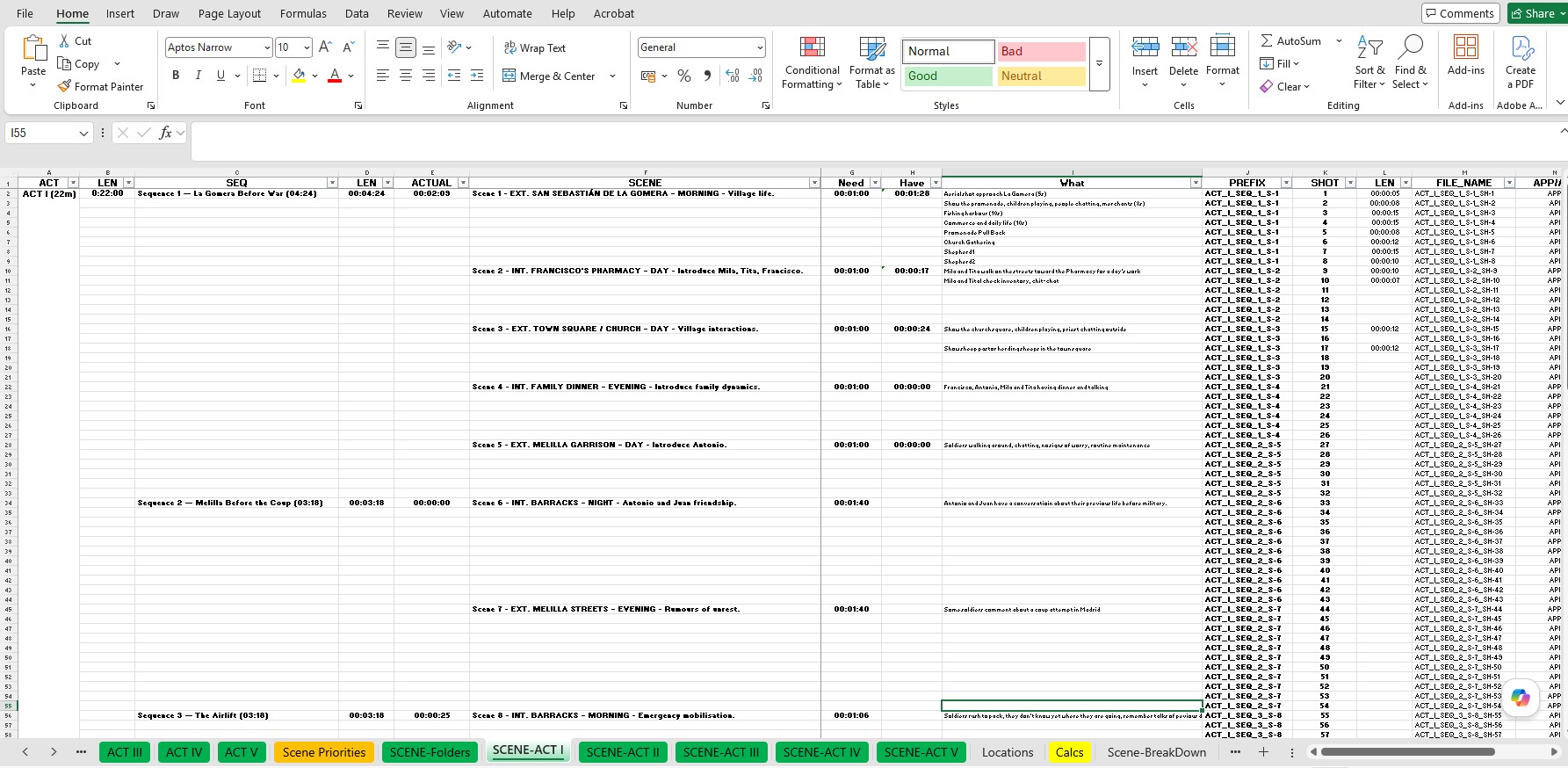
The story became divided into acts, sequences and scenes.
Each scene received an identifier.
Each generated clip followed a strict naming convention.
Timelines became production schedules.
Spreadsheets became shot trackers.
Version control became essential.
- 105 minutes
- 5 ACTs
- 42 Sequences
- 103 Scenes
- 706 Shots (and growing)
What initially looked like creativity gradually transformed into project management.
And surprisingly…
I loved it.
Budgeting an AI Film
Traditional films have cameras, crews and locations.
AI films have another currency – Credits.
Every generation costs something.
A beautiful establishing shot may take dozens of attempts.
A seven-second clip might require multiple iterations before character consistency, movement, lighting and emotion finally align.
Very quickly you stop asking: “Can I generate this?”
Instead you begin asking: “Is this scene worth generating?”
That subtle shift changes how you write.
You become economical, Intentional.
Almost ruthless.
Ironically, limitations improve storytelling.
Writing for Machines… and Humans
I expected writing prompts.
I did not expect writing screenplays.
There is a significant difference.
A screenplay exists to communicate intention to actors and crew.
An AI prompt exists to communicate intention to a model.
Those are not the same language.
Over time I found myself developing intermediate layers between the screenplay and the final prompt.
Character descriptions became structured “Character Bibles.”
Locations evolved into “Location Bibles.”
Historical references accumulated into research collections.
It felt strangely familiar.
Almost like compiling source code.
Except the output wasn’t software.
It was cinema.
Falling Down Historical Rabbit Holes
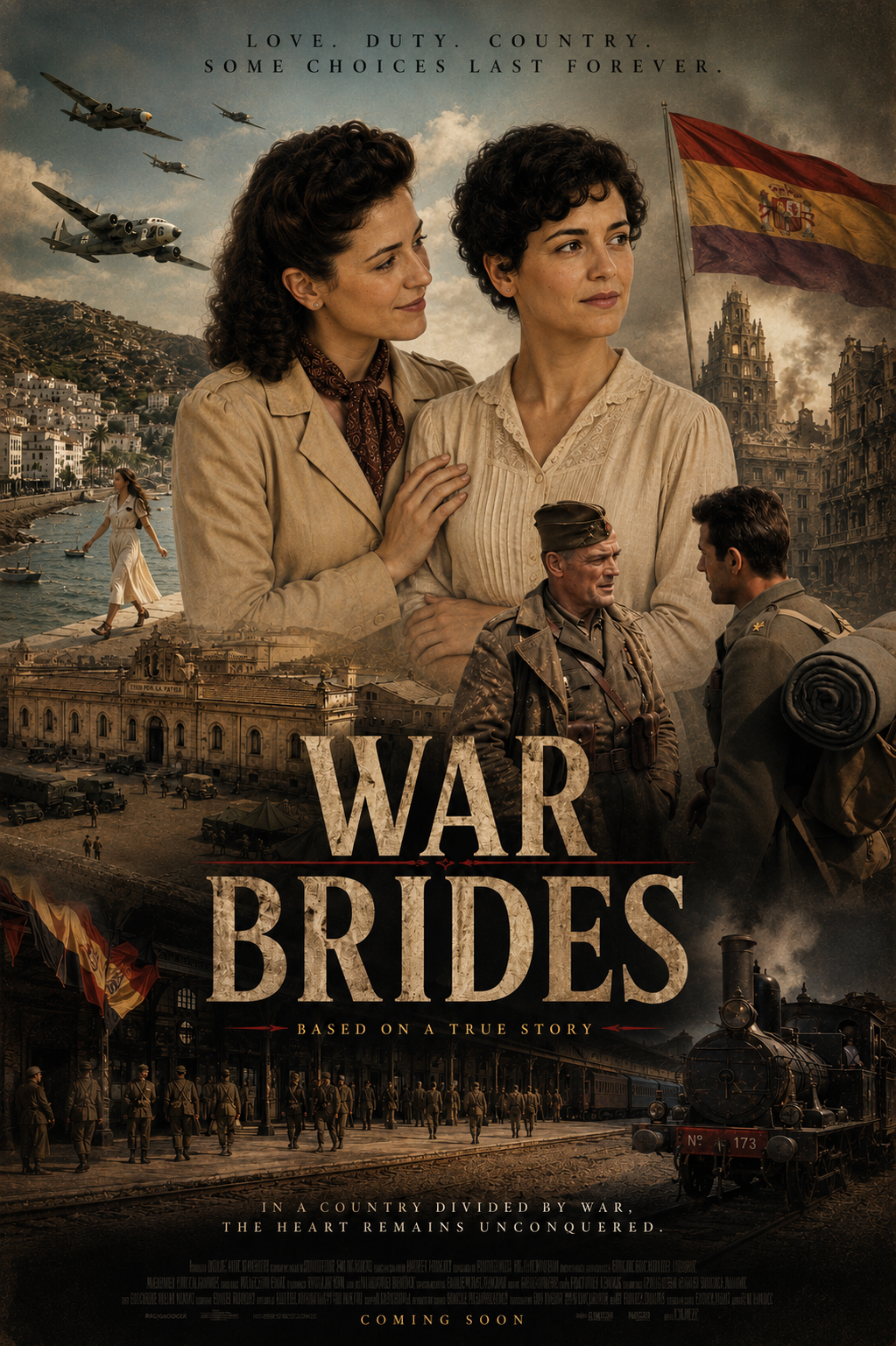
War Brides is inspired by my own family history during the Spanish Civil War and the years that followed.
That immediately created another challenge.
Historical authenticity.
Not historical perfection.
Authenticity.
I spent countless hours researching uniforms, architecture, radios, pharmacy interiors, steamships, military ranks, dialects, transport routes, immigration records and even what people might realistically have known on a particular day in 1936.
The deeper I researched, the more I realized that history is rarely clean.
Family memories overlap with documented facts.
Official records sometimes disagree.
Cinema, however, requires coherent narratives.
That meant making careful choices.
Not to rewrite history.
But to respectfully bridge the gaps where history naturally leaves room for interpretation.
Romanticizing Reality Without Betraying It
This became one of the hardest balances.
Real life rarely follows satisfying dramatic structure.
People survive by chance.
Letters arrive too late.
Opportunities disappear for reasons nobody understands.
Films demand emotional rhythm.
Reality often refuses to cooperate.
Throughout War Brides, I constantly found myself asking: “Would this have happened?”
Closely followed by: “Could this have happened?”
That distinction became incredibly important.
The first seeks certainty.
The second seeks plausibility.
Cinema often lives in that space.
AI Doesn’t Replace Taste
Perhaps, again, one of the biggest misconception surrounding AI is that it automates creativity.
After spending months building this project, my conclusion is almost the opposite.
AI amplifies taste.
It rewards preparation.
It rewards clarity.
It rewards patience.
The better your artistic judgement becomes, the better your results become.
The models generate possibilities.
You still curate them.
The machine produces variations.
You decide which one deserves to exist.
That feels remarkably human.
Learning to Slow Down
There were moments where I became frustrated.
A scene refused to work.
A character’s expression felt wrong.
Lighting changed unexpectedly.
Continuity broke.
The temptation was always to keep generating.
Instead, I gradually learned to stop.
Watch.
Study.
Think.
Sometimes the solution wasn’t another prompt.
It was rewriting the scene.
Changing the camera angle.
Removing dialogue.
Or even deleting the scene entirely.
Ironically, AI encouraged me to become more deliberate, not less.
A New Respect for Filmmakers
Before this project I admired directors.
Now I also admire editors and the whole crew.
Editors understand rhythm.
They understand restraint.
They know what not to show.
Building War Brides has fundamentally changed how I watch films.
I no longer simply see stories.
I notice shot composition.
Transitions.
Continuity.
J-cuts.
L-cuts.
Blocking.
Color palettes.
Every film has quietly become a masterclass.
The Real Project
People often ask me whether War Brides is an AI film.
I don’t think that’s the interesting question.
The interesting question is what the project changed in me.
It transformed me from someone experimenting with AI tools into someone studying storytelling itself.
The technology may continue evolving rapidly.
Models will improve.
Video quality will improve.
Consistency will improve.
But the skills that matter most remain surprisingly timeless:
Curiosity.
Empathy.
Patience.
Observation.
Structure.
Taste.
Those were never artificial.
And perhaps that’s the most unexpected lesson of all.
AI didn’t make filmmaking easier.
It made me appreciate just how extraordinary filmmaking has always been.
Disclaimer: This post has been generated and/or enhanced with the assistance of artificial intelligence tools, using information available and believed to be current and accurate at the time of creation. However, the content may include speculative, interpretive, or subjective elements and does not necessarily reflect objective reality. The views and opinions expressed are solely those of the author and do not represent or imply the views of any employer, organization, or affiliated individuals. No endorsement, verification, or review by any such entities has been conducted or should be inferred.
