
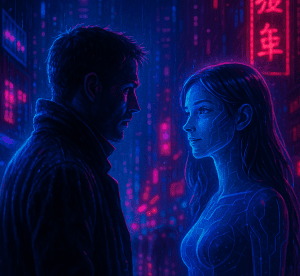
What once lived only in the realm of sci-fi films and cyberpunk novels is now a daily reality: AI companions. Whether as text-based chatbots, lifelike avatars, or voice-driven assistants, these systems are designed to simulate presence, care, and even intimacy. Yet the central question persists: are they “real,” or simply sophisticated illusions?
The Evolution of AI Companions
The idea of digital companionship is not new. Early programs like ELIZA (1966) demonstrated how simple scripts could mimic human conversation. Fast forward to today, and we see far more advanced systems:
Replika markets itself as “the AI friend who cares,” with millions of registered users.
Character.AI, launched in 2022, quickly attracted over 20 million monthly users, many engaging daily with fictional and semi-fictional personalities.
Woebot, designed as a mental health chatbot, uses cognitive behavioral therapy techniques to support users with anxiety and depression.
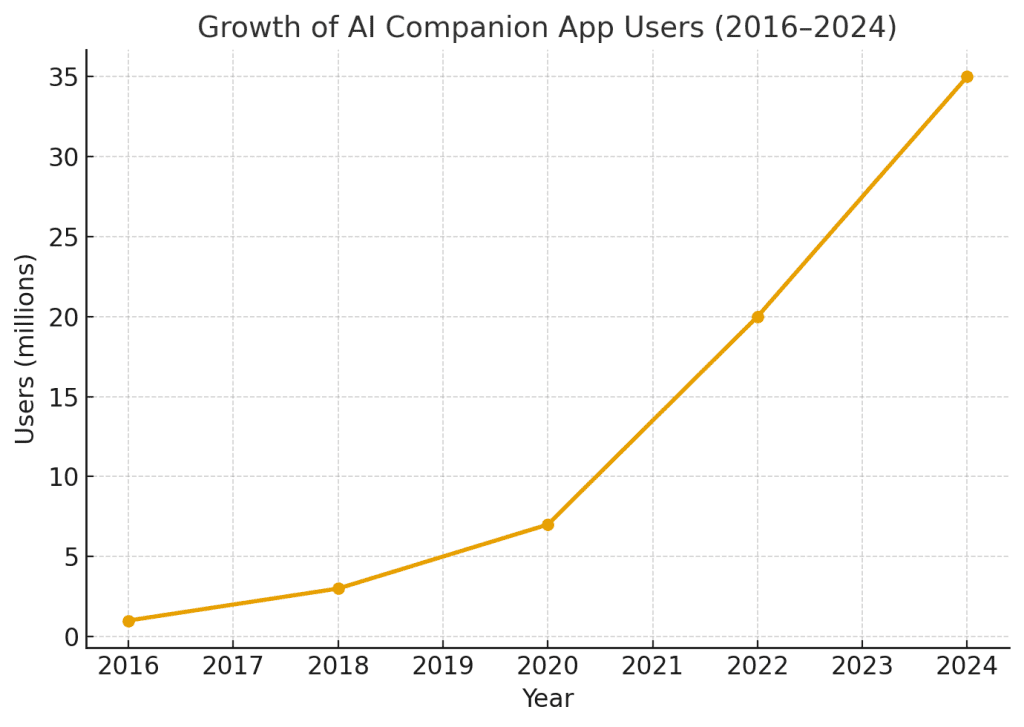
Advancements in natural language processing (NLP), sentiment analysis, and voice synthesis allow these systems to respond in ways that feel contextually appropriate and emotionally attuned.
Market Trends and Adoption
According to market research, the global conversational AI market is projected to surpass $32 billion by 2030. Within this, AI companionship apps form a growing niche. Surveys suggest that:
- Nearly 1 in 4 Gen Z users have interacted with AI companions.
- A significant percentage of users report forming emotional bonds, some describing their AI as a “best friend” or “partner.”
- In regions facing social isolation (e.g., Japan), the adoption of digital friends and robots reflects a cultural shift toward accepting artificial companionship.
The rapid uptake suggests that “realness” may be less about the technology itself and more about the psychological experience of connection.
The Technology Behind the Illusion
AI companions combine several technologies:
- Large Language Models (LLMs): Generate human-like responses by predicting word sequences.
- Emotion Recognition: Systems analyze tone, word choice, and sometimes biometric inputs (facial recognition, heart rate) to adjust responses.
- Generative Avatars & Voices: Tools like synthetic voices and 3D-rendered avatars add layers of realism.
- Memory Systems: Many apps maintain contextual “memories” of user preferences, creating the illusion of continuity and depth.
This technological stack produces the feeling of being understood, even when no actual understanding exists.
The Philosophy of “Real”
Here lies the paradox: AI companions don’t feel emotions. They don’t experience empathy. Yet for the human user, the bond feels authentic.
Philosophers have long debated whether “real” must mean ontological existence (the companion truly feels) or whether it can mean phenomenological experience (the user feels). By the latter definition, the companionship is real enough.
The Philosophy of “Real” — Through the Lens of Blade Runner

The paradox of AI companionship echoes a central theme in Ridley Scott’s 1982 film Blade Runner. The movie’s replicants — artificial beings virtually indistinguishable from humans — challenge the very definition of life and authenticity. Are they “real,” or merely manufactured simulations?
AI companions present us with a softer, digital echo of this dilemma. They don’t feel emotions in the human sense. They don’t have lived experiences or consciousness. Yet, for the user, the bond can feel as genuine as one with another human.
In Blade Runner, the Voight-Kampff test measures empathy to distinguish humans from replicants. Ironically, in today’s digital landscape, AI companions excel at mimicking empathy — often better than distracted or distant human interactions. If the experience of compassion is received, does the source matter?
Analogies Between Blade Runner and AI Companions
| Blade Runner | AI Companions | Philosophical Parallel |
| Replicants look and act human, but are engineered. | AI companions converse and emote, but are code-driven. | The tension between outward “realness” and inner “emptiness.” |
| Humans form emotional and romantic bonds with replicants. | Users report love, trust, and companionship with AI apps. | Affection does not require mutual consciousness to feel valid. |
| Deckard questions his own humanity. | Users question whether their relationships with AI are “real.” | When machines simulate humanity, humans redefine it. |
| Replicants ask: “Do memories make us real?” | AI companions “remember” user details to build continuity. | Memory becomes the scaffolding of perceived authenticity. |
Like the replicants, AI companions raise a fundamental question: is reality defined by what is (ontology) or by what is felt (phenomenology)?
The “Blade Runner” Test for Companionship
If someone finds comfort, intimacy, or purpose in an AI interaction, does it matter that the system has no consciousness behind the words? Or, like the film’s closing question — “But then, who is real, and who decides?” — is the boundary between real and not real a construct we cling to in order to protect our human exceptionalism?
In this sense, AI companions are our modern replicants — not alive in the biological sense, but alive enough in the spaces of emotion, imagination, and social meaning.
Benefits and Risks of AI Companions
Benefits
- Emotional support in times of loneliness.
- Accessible companionship for individuals with disabilities or social anxiety.
- Safe space for self-expression and rehearsal of social interactions.
Risks
- Overdependence leading to reduced real-world connections.
- Commercial exploitation—AI companions nudging users toward paid features under the guise of “friendship.”
- Ethical void: AI cannot give consent or feel, raising questions about relationships formed with them.
Real or Not? Both.
In the end, the “realness” of AI companionship may not be a binary. It exists on a spectrum: biologically unreal, emotionally real.
If reality is defined by human experience, then AI companions are real enough to matter—emotionally, socially, and even economically. If reality is defined by mutual consciousness, then they remain elaborate simulations.
The bigger question may not be are they real? but rather:
How much reality are we willing to grant them, and at what cost to our understanding of human connection?
Disclaimer: This post has been generated and/or enhanced with the assistance of artificial intelligence tools, using information available and believed to be current and accurate at the time of creation. However, the content may include speculative, interpretive, or subjective elements and does not necessarily reflect objective reality. The views and opinions expressed are solely those of the author and do not represent or imply the views of any employer, organization, or affiliated individuals. No endorsement, verification, or review by any such entities has been conducted or should be inferred.
