
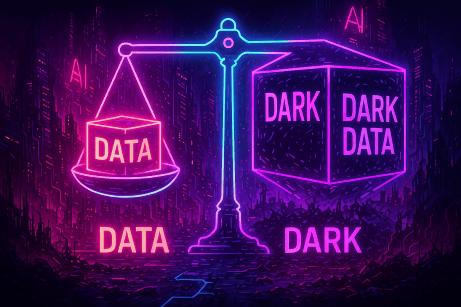
For years, the business world has been told that “data is the new oil.” Investors, executives, and consultants predicted that companies would monetize data at scale, using artificial intelligence and big data analytics to unlock new sources of growth.
But reality has fallen short. While enterprises continue to hoard vast amounts of information, the success rate of AI and big data initiatives remains stubbornly low. Gartner has estimated that up to 85% of big data projects fail1. Instead of fueling an AI-driven bonanza, much of that data ends up as dark data – collected and stored, but never used.
What Exactly Is Dark Data?
Gartner defines dark data as the information assets that organizations collect, process, and store during regular business activities but fail to use for other purposes – such as analytics, business relationships, or monetization. Think of it as the forgotten byproduct of data collection.
Examples include:
- Customer call logs that never get analyzed for satisfaction trends.
- Server logs capturing website activity but ignored after a week.
- Old employee records stored indefinitely with no real business value.
- IoT sensor data that’s collected in bulk but rarely mined for patterns.
Just like dark matter in physics, dark data makes up the majority of an organization’s information universe – often estimated to be more than 50% and up to 80% of all collected data.
Why Is So Much Data Left Unused?
There are several reasons why organizations allow data to go dark:
Volume Overload – With the exponential growth of digital touchpoints, companies collect more data than they can realistically process.
Storage Is Cheap, Analysis Isn’t – Cloud storage costs less than ever, so companies keep everything “just in case,” even if they don’t know how to use it.
Siloed Systems – Data often gets trapped in isolated applications or departments, making it hard to integrate and analyze.
Uncertainty of Value – Sometimes, organizations don’t recognize the potential value of certain datasets until it’s too late.

The Expectation vs. Reality Gap
| Expectation | Reality |
|---|---|
| Every dataset could generate competitive advantage. | Most data is unstructured, siloed, or too messy to integrate effectively2. |
| AI would automate decision-making and unlock hidden insights. | AI models require clean, labeled, and well-governed data, which is often in short supply3. |
| Data itself would become a revenue stream. | Few companies have successfully monetized their data directly, and most are still wrestling with compliance and governance basics4. |
The result? Vast stores of dark data, quietly draining resources and representing missed opportunities.
Promise vs. Outcome
Retail – Customer Data Goldmine That Wasn’t
Retailers rushed to collect every click, cart, and customer service transcript. The promise was personalized experiences and predictive demand forecasting. In practice, many chains ended up with disconnected silos of customer data5.
- Several big-box retailers invested heavily in personalization engines, only to abandon them after failing to clean and align customer data across channels. Instead of hyper-personalization, customers got generic offers and abandoned carts.
Healthcare – Data Rich, Insight Poor
Healthcare is one of the most data-intensive industries, generating mountains of patient records, imaging, and sensor data. AI promised breakthroughs in diagnosis and personalized medicine. But privacy regulations, fragmented systems, and inconsistent data quality have slowed progress6.
- Hospitals investing in predictive analytics for readmission rates often found that their EHR data was incomplete or incompatible across departments. The result: AI models trained on poor-quality data that underperformed in real-world use.
Finance – Trading on the Data Dream
Banks and insurers have long been data-driven industries. The rise of big data promised fraud detection, credit scoring, and algorithmic trading at unprecedented accuracy. Yet, most firms still struggle with data governance and real-time integration7.
- Some major banks launched AI-based lending pilots, only to discover that their historical loan data carried systemic biases. The models performed poorly in practice, and the banks faced regulatory backlash instead of market advantage.
In all three industries, the story is the same: the data was there, the hype was high, but much of the value never materialized. Instead, the data sits in storage as dark data—expensive, risky, and underutilized.
The Risks of Dark Data
While it may seem harmless to let unused data pile up, dark data carries hidden risks:
- Security and Compliance Threats – Unmonitored data often contains sensitive information (like personal details, financial records, or intellectual property). If breached, it can lead to fines and reputational damage.
- Increased Costs – Storing vast amounts of unused data consumes infrastructure and maintenance resources.
- Lost Opportunities – Buried in dark data might be insights that could improve customer experience, optimize operations, or create new revenue streams.
Why the Bonanza Never Arrived
The gap between promise and outcome comes down to structural barriers:
- The Cost of Clean Data – Most budgets go to cleaning, labeling, and integrating data, not building AI models8.
- Hype Over Readiness – Many invested in AI without strong foundations in governance and data quality9.
- Volume vs. Value – Companies collected “everything,” only to discover most of it was irrelevant or redundant10.
- Privacy and Regulation – Consumer protection laws limit how data can be exploited, complicating monetization plans11.
Moving Beyond Dark Data
If dark data symbolizes the broken promises of big data, the way forward is not more collection, but smarter curation:
- Prioritize quality over quantity – Focus on datasets tied to clear business outcomes.
- Invest in governance – Metadata management, lineage tracking, and compliance must come first.
- Adopt lifecycle management – Define when to actively use, archive, or delete data.
- Refocus AI – Shift from grand “moonshot” projects to narrow, domain-specific applications with proven ROI.
From Bonanza to Balance
The AI and big data era promised a gold rush. What we got instead was a mountain of dark data—unused, unmonetized, and unfulfilled. But the failure isn’t inevitable. By reframing expectations, focusing on quality, and investing in governance, organizations can start to turn the darkness into opportunity.
The winners won’t be those who hoard the most data. They’ll be those who curate the right data and deploy it with precision.
✅ Takeaway: Dark data is the evidence of a gap between the data-driven bonanza we were promised and the messy reality of failed projects. Success in the next wave of AI will come not from collecting everything, but from curating carefully and executing deliberately.
Big Data & AI Project Failure Rates
- A 2014 Capgemini study reported that “only 27% of big data projects are regarded as successful,” with merely 13% reaching full-scale production and 8% deemed very successful Medium – Data Science PM.
- Insight Softmax cites Gartner estimates suggesting failure rates of 60% to as high as 85% for data science and AI projects insightsoftmax.com.
- A Medium article further highlights a Gartner analysis pegging failure rates at 85% Medium.
- LUMIQ’s Medium post echoes this, noting that 85% of big data analytics projects fail Medium.
- Telepathy Infotech adds: 85% of AI projects failed to deliver expected outcomes, citing poor data quality and bias as primary reasons telepathyinfotech.com.
Dark Data Explained
- The Wikipedia entry on Dark Data estimates that about 90% of data generated by sensors and analog-to-digital conversions goes unused, and organizations may only analyze 1% of their total data Wikipedia.
Industry Case Study Themes & Examples
- While direct academic case studies are sparse in our search results, you can leverage the following contextual sources for supporting examples:
- Dark Data applications in contexts like system logs and AI-based analysis, emphasizing predictive maintenance and compliance, are explored in a recent article on AI in Dark Data Mining AICompetence.org.
- Ethical implications of AI in retail, especially consumer privacy and fairness concerns, are discussed in Adanyin’s 2024 study on Ethical AI in Retail arXiv.
- The Wikipedia entry on Big Data offers real-world retail usage examples—Walmart’s enormous data volumes, omnichannel implementations, and more Wikipedia.
- Though not strictly failure examples, real-world compliance failures in data handling—especially in finance and healthcare—are summarized in a 2025 data analyst article: 60% of firms faced penalties, some fines exceeded $300 billion globally MoldStud.
Summary of References
- Capgemini (2014): Only 27% of big data projects considered successful; 13% in full-scale production; 8% very successful Data Science PM. ↩︎
- Gartner (via Insight Softmax, 2024): Data science failure rates range between 60% (2016) and 85% (2017) insightsoftmax.com. ↩︎
- Medium (Daniel Buchuk, 2021): Highlights Gartner’s 85% failure estimate for data science projects Medium. ↩︎
- Medium (LUMIQ Tech, 2024): Reiterates 85% failure rate for big data analytics projects Medium. ↩︎
- Telepathy Infotech (2025): Reports 85% of AI projects fail due to poor data quality and bias telepathyinfotech.com. ↩︎
- Wikipedia (Dark Data): States around 90% of sensor-generated data goes unused; only ~1% of data analyzed Wikipedia. ↩︎
- AI Competence (2025): Explores how AI can unlock value from dark data through governance, predictive maintenance, and compliance AICompetence.org. ↩︎
- Adanyin (2024): Discusses ethical challenges in AI deployment in retail, such as privacy and fairness arXiv. ↩︎
- Wikipedia (Big Data): Provides real-world industry examples like Walmart’s data volume and omnichannel use cases Wikipedia. ↩︎
- MoldStud Research (2025): Notes that 60% of firms faced penalties due to poor data compliance; fines exceeded $300 billion MoldStud. ↩︎
- Adanyin (2024). Ethical AI in Retail: Privacy and Fairness Challenges. arXiv ↩︎
Disclaimer: This post has been generated and/or enhanced with the assistance of artificial intelligence tools, using information available and believed to be current and accurate at the time of creation. However, the content may include speculative, interpretive, or subjective elements and does not necessarily reflect objective reality. The views and opinions expressed are solely those of the author and do not represent or imply the views of any employer, organization, or affiliated individuals. No endorsement, verification, or review by any such entities has been conducted or should be inferred.
