

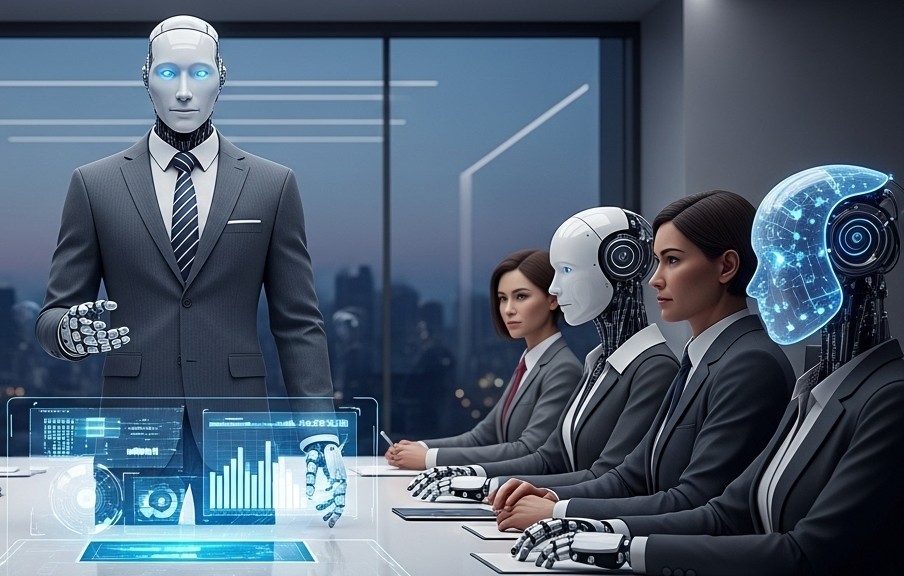
Machines that can autonomously manage other machines is not a fanciful sci-fi trope — it is increasingly our operational reality: systems of sensors, algorithms, controllers, and autonomous agents coordinating with minimal human oversight.

As we ride this wave, we face profound questions: which human tasks are ceded to machines, how do we manage displacement, and how do we ensure that automation ultimately empowers rather than disenfranchises?
This article walks through the evolution of this trend over the past five years, forecasts its trajectory over the next decade, surfaces the main challenges, and offers a tempered but optimistic case for how humanity can benefit.
A Retrospective: The Last Five Years (≈ 2020–2025)
To understand where we’re going, it’s worth briefly surveying where we are:
The adoption of AI, robotics, and process automation has accelerated across industries. According to the Future of Jobs Report 2023 from the World Economic Forum, nearly 75 % of surveyed organizations expect to adopt AI in core operations, reflecting strong momentum behind algorithmic transformation. World Economic Forum
Industrial automation (robotics, process control, systems integration) has also expanded robustly. According to a recent report, the global industrial automation market was valued at around USD 169.8 billion in 2024 and is projected to grow to USD 443.5 billion by 2035 (a compound annual growth rate of roughly 9.12 %) Roots Analysis
On the labor front, multiple forecasts have signaled substantial disruption. For example, McKinsey has estimated that between 400 million and 800 million individuals globally may need to adapt by 2030 due to automation-induced shifts in work. McKinsey & Company
Multiple research corroborate that by 2030, up to 30 % of current jobs could be automated, and 60 % could see significant task-level change under AI enhancements. Forbes
Yet the transition is not wholesale or uniform: in the U.S., for instance, preliminary modeling suggests that 1.6 to 3.2 million jobs (around 1–2 % of employment) are at direct risk over the next two decades via AI-driven automation — a nontrivial but not apocalyptic figure. Massachusetts Institute of Technology
One consistent theme across studies is that while jobs will change, many will be transformed rather than eliminated outright, with new roles arising in oversight, augmentation, coordination, and entirely new domains.
From 2020 to 2025, then, we might see this period as a kind of “incubation” of intelligent automation — experimentation, pilot systems, gradual rollout, organizational learning, and early dislocations.
Projecting Forward: The Next Ten Years (2025–2035)
Over the coming decade, the machines-managing-machines paradigm is likely to broaden in depth and scope. What follows is a plausible, though speculative, trajectory:
2025–2030: From Augmentation to Autonomy
Wider deployment of “ecosystem automation”: According to Blue Prism, one of the emerging trends is moving from isolated automation (RPA, simple process bots) toward orchestrated systems that coordinate across processes, APIs, and departments. SS&C Blue Prism
Agentic AI & autonomous agents become more common in mid-tier operations: in supply chains, logistics, IT operations, infrastructure, security, and orchestration of cloud and edge resources.
Governance, safety, and compliance tooling must catch up: as automation autonomy increases, oversight, auditability, and governance frameworks become essential.
Labor churn and reskilling pressure intensifies: organizations may accelerate reskilling programs, internal mobility, modular job design, and “human + AI” collaboration models.
Hybrid human-machine oversight: Many systems will still require human-in-the-loop control, especially in uncertain, high-stakes, or novel contexts.
Selective job displacement but net job creation: For example, one “Future of Jobs 2025” forecast suggests displacement of 92 million roles but creation of 78 million new ones — a net loss in some models, a net gain in others depending on region and sector. Exploding Topics
2030–2035: Autonomy, Scale, and Institutional Effects
High autonomy in stable domains: In domains like manufacturing, basic logistics, energy grid balancing, some parts of finance, autonomous systems may run with minimal human oversight.
Self-optimizing systems: Systems may continuously monitor their own performance, detect drift or inefficiency, and reconfigure themselves (e.g. dynamic load balancing, adaptive scheduling, self-healing).
Emergence of “meta-controllers”: Higher-order systems might oversee multiple lower-level autonomous systems, dynamically allocating resources, risk budgets, or coordination strategies.
Institutional reconfiguration: Entire industries (transportation, warehousing, supply chain, utilities) may see structural shifts: fewer but larger players, increased consolidation, new intermediary roles in supervision, regulation, and orchestration.
Regulation, ethics, and labor policy become central: Governments and multilateral institutions will need to grapple with liability, accountability, algorithmic bias, social safety nets, universal basic income-like policies, and lifelong learning infrastructure.
Wider diffusion to non-industrial domains: Domains like policy planning, R&D automation, urban infrastructure control, healthcare monitoring, environmental optimization or energy management may see stronger adoption of “machines managing machines.”
By 2035 it’s plausible that a significant proportion of routine operational decisions in business, infrastructure and logistics will be made by hierarchical autonomous systems with humans exerting supervisory roles, exception-handling activities, and performing design and strategic roles.
Challenges & Risks
This transition is far from frictionless. Some of the key challenges include:
- Job displacement and inequality
- Even if net employment remains positive, many workers may be dislocated, particularly those in lower-skill, repetitive, or administrative jobs.
- Several studies note that low-wage workers are much more vulnerable to displacement: for instance, McKinsey’s analysis found that low-wage earners are about 14 times more likely to face AI-driven job loss than higher-wage workers. Axios
- Disparities across geographies, sectors, education levels and demographics (age, gender, race) can exacerbate inequality.
- The speed of transition matters — structural unemployment may arise if displaced workers cannot retrain quickly enough.
- Skill and re-skilling gap
- The required skills shift: from manual or routine tasks to critical thinking, systems oversight and uplifting paths into decision-making and human–AI collaboration.
- Many regions and smaller institutions may lack the capacity for large-scale retraining, instill lifelong learning systems or the ability to adapt education curricula to fast upcoming trends.
- Governance, accountability, and trust
- Autonomous systems may go awry — algorithmic bias, cascading failures, decision opacity, or unintended consequences may unpredictably ensue.
- Who is liable when a machine-managed decision causes harm?
- Regulation often lags technology; frameworks for safety, auditing and transparency are still nascent in the context of AI automation.
- Concentration of power and consolidation
- As automation requires capital, infrastructure, and data, firms with scale advantage (big tech, platform companies, specialized automation vendors) may dominate, possibly out shadowing smaller players.
- Access to data, AI models, and infrastructure could centralize control, creating new dependencies.
- Resilience & systemic risk
- Highly automated, tightly orchestrated systems may suffer from cascading fragility: a fault in one node could ripple across entire supply chains or ecosystems.
- Cybersecurity becomes more critical — attacks on the “machines managing machines” layer might produce globalized disruption.
- Ethical, social, and human dignity concerns
- Over-automation risks alienating humans from decision-making roles, reducing agency and meaning in work.
- Surveillance, privacy, worker autonomy and worker rights may be challenged in highly automated systems.
- Energy, resource, and infrastructure constraints
- More automation and AI processing means rising energy and hardware demands. Data centers, edge infrastructure and sensor networks must scale.
- There is a tension between scale and sustainability.
Addressing these challenges will require holistic thinking: technology, policy, institutions, incentives, culture and ethics must evolve in tandem.
The Human-Centric Tonic: Why This Could Be a Net Benefit
Although the shift will bring dislocations, there are strong reasons to believe that it can, over time, be a net benefit for humanity — if guided well.
Productivity, prosperity, and new possibilities
- Faster innovation cycles: Autonomous systems can iterate, test, and optimize far more rapidly than human-only systems, fueling breakthroughs in science, materials, medicine or energy.
- Lower cost for essential services: Infrastructure, utilities, sanitation, logistics, renewable energy — these are domains where automation can deliver lower-cost, higher-quality and translate in ubiquitous services (commoditized AI).
- Improved safety and risk management: Machines can operate in hazardous environments (deep sea, space, disaster zones), reducing human risk.
- Focus humans on higher-level work: If routine work is automated, humans can spend more time on creativity, strategy, empathy, design, oversight, ethics, care and culture, all attributes that define humanity.
- Democratization via platform access: As automation tools mature, “automation-as-a-service” platforms may lower the barrier to entry, allowing smaller firms or communities to deploy sophisticated systems – such concept has been discussed in an earlier post at CrazyData.eu.
A more equitable future — if arranged well
- Lifelong learning & capability building: If we invest in continuous education ecosystems, many displaced workers can transition into higher-value roles.
- Redistribution and social safety nets: Policy structures (e.g. universal basic income, wage insurance, negative income tax, support for retraining) can buffer transitions.
- New mission-oriented fields: Many of humanity’s greatest challenges — climate change, biodiversity, public health or global coordination — may call for large-scale automated systems; machines can amplify human purpose.
- Ethical automation models: With governance protocols, transparency, human-in-the-loop design, and regulatory guardrails, we can embed human values into the architecture of automation rather than accept “black-box” systems.
- Resilience by redundancy and “human fallback”: Hybrid designs enable fallback to human control. Autonomy need not mean human exclusion.
In short: the transition from human-managed machines to machines managing machines can be a powerful multiplier of human potential — if ethics, institutions, public investment and governance keep pace.
A Tentative Timeline (2020–2035) Summary
| Phase | Approx Years | Dominant Character | Key Features / Risks |
| Incubation & Pilots | 2020–2025 | Human-augmented systems | Experiments, early automation, modest displacement |
| Transition & Scaling | 2025–2030 | Autonomous subsystems | Ecosystem orchestration, workforce churn, governance catch-up |
| Broad Autonomy & Institutional Shift | 2030–2035 | Hierarchical autonomous architectures | Deep automation, structural change, regulatory tension, human oversight layer |
This 15-year window is speculative, and the exact pace will depend heavily on technical breakthroughs, capital flows, regulatory frameworks, public acceptance and global competition dynamics.
Strategic Considerations
In line with the bold, data-driven, human-centric spirit of crazydata.eu, here are some guiding principles and strategic levers as we move into this machine-managed future:
- Design for “augmentability”, not replacement
Build systems to complement human strengths — let machines do the rote, humans steer the ambiguous. Prioritize interfaces, transparency, feedback loops and auditability. - Invest heavily in lifelong learning infrastructure
Flexible reskilling programs, micro-credentials, modular education, “stackable” learning paths – digital learning platforms must become core public and private investments. - Build governance and audit layers early
Autonomous systems should include built-in logging, accountability, version control, “off-switches,” and monitoring — not as afterthoughts but as first-class design. - Foster decentralization and open frameworks
Too much centralization risks monopolies. Promote standards, open APIs, interoperable protocols, community-driven automation and automation toolkits accessible to small players. - Align incentives to shared prosperity
Profit motives alone may shortchange social welfare. Encourage models where automation gains are partly shared: revenue-sharing, stakeholder dividends, worker-ownership, public-private partnerships. - Plan for resilience and fallback
Ensure hybrid modes, human override paths, redundancy, defensive isolations and recovery protocols to prevent cascading failures. - Anticipate a “new social contract”
Public policy should evolve — from taxation, welfare, wealth redistribution, regulation of data and AI to redefining work, leisure, identity and civic duty in increasingly automated societies.
Toward a Human-Centered Automation Future
“Machines managing machines” is not a dystopian inevitability — it’s an engineering and systems architecture frontier. The real question is not whether it will happen, but how we guide it. Between now and 2035, we are likely to see many familiar tasks become autonomous, roles shift, and systems take on more of their own supervision.
Yes, risks abound: displacement, inequality, governance gaps, fragility.
But the upside is compelling: greater productivity, lower costs, more time for human creativity and the possibility that our machines become collaborators—not adversaries.
If humanity anchors this transition with ethics, fairness, foresight, transparency and shared purpose, we may emerge not dominated by our machines but empowered by them.
Disclaimer: This post has been generated and/or enhanced with the assistance of artificial intelligence tools, using information available and believed to be current and accurate at the time of creation. However, the content may include speculative, interpretive, or subjective elements and does not necessarily reflect objective reality. The views and opinions expressed are solely those of the author and do not represent or imply the views of any employer, organization, or affiliated individuals. No endorsement, verification, or review by any such entities has been conducted or should be inferred.
