
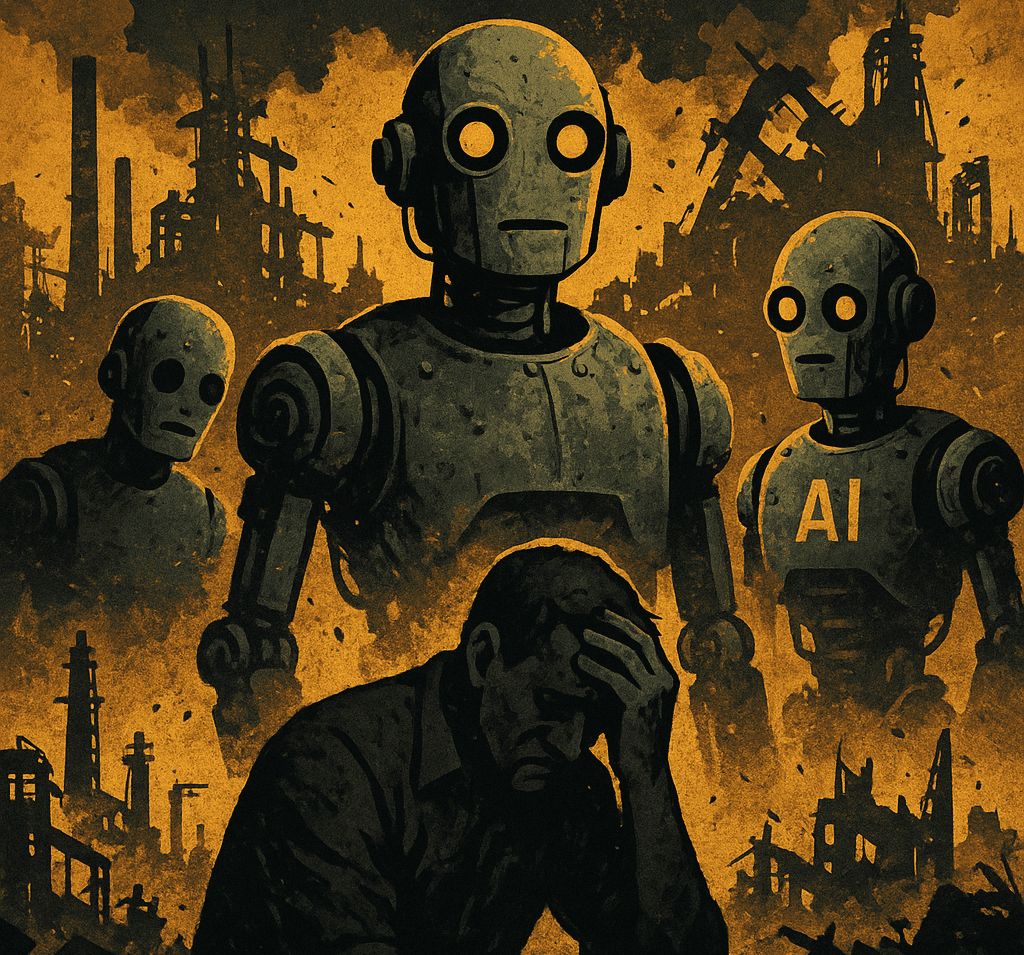
The Industrial Revolution reshaped the global economy, and the Digital Revolution pushed it further. But now, as automation and artificial intelligence (AI) replace human labor at an unprecedented pace, a paradox emerges: the more efficient production becomes, the less consumers can afford to buy. This post explores how the rapid advancement of AI and automation is accelerating economic collapse and what it means for the future of industry, commerce, and civilization itself.
How Technological Advancements Increase Productivity but Reduce Consumer Purchasing Power
The implementation of AI and automation in production has led to a dramatic increase in efficiency, reducing costs and improving output. Businesses that once relied on human labor to perform repetitive tasks can now automate these processes, achieving productivity gains never seen before. For example, in the manufacturing sector, robotics have replaced assembly line workers, slashing operational costs and improving precision. In the service sector, AI-driven customer service bots, automated checkouts, and smart supply chains have streamlined operations, eliminating redundancies and enhancing speed.
However, this advancement comes with a significant drawback: widespread job displacement. As companies adopt automation, fewer workers are needed, leading to unemployment and reduced wages for those who manage to retain their jobs. The result is a shrinking consumer base with diminishing purchasing power. Historically, economic growth has been driven by a balance between production and consumption—when workers are paid well, they spend more, which fuels demand and drives further production. But when automation eliminates jobs, disposable income declines, and demand falters. This economic paradox—where production soars but affordability plummets—threatens to destabilize entire industries.
Historical Parallels with the Industrial Revolution and the Great Depression
History provides us with critical lessons about the consequences of rapid technological advancement. The Industrial Revolution of the 18th and 19th centuries saw mechanization replace many manual labor jobs, leading to widespread social unrest and economic realignment. The introduction of steam power and mechanized looms, for instance, drastically increased textile production but simultaneously rendered thousands of skilled weavers jobless. The Luddites, a group of workers who resisted automation, famously destroyed machinery in protest of job losses.
Similarly, the Great Depression of the 1930s highlighted the dangers of economic imbalance. Overproduction in industries like agriculture and manufacturing led to supply surpluses, but because wages were stagnant and unemployment was rising, there weren’t enough consumers to purchase the goods. This demand shortfall resulted in deflation, bankruptcies, and economic collapse. Today, AI and automation present a comparable risk on a larger scale. Companies are producing more with fewer workers, but as automation continues to displace jobs across industries, there’s a real risk of falling into a deflationary spiral similar to the Great Depression, where an excess of goods meets a lack of consumers.
The Shift from a Labor-Driven Economy to Capital-Intensive Automation
For centuries, economic prosperity was built on labor—the idea that employment creates income, which in turn fuels demand for goods and services. This cycle of productivity and consumption sustained growth and innovation. However, with the advent of AI and automation, economies are shifting from being labor-driven to capital-intensive.
Businesses are investing more in AI, robotics, and machine learning systems rather than in human workers. Unlike human employees who require wages, benefits, and breaks, machines can work around the clock with minimal maintenance costs. This shift means that wealth accumulation is becoming more concentrated among capital owners—those who can afford to invest in automation—while the majority of the population faces declining economic opportunities.
One major consequence of this shift is rising income inequality. Wealth is increasingly concentrated among the tech elite and major corporations, while wages stagnate or decline for the majority of the workforce. Without intervention, this imbalance could lead to economic stagnation, social unrest, and a fundamental restructuring of how economies function. If traditional labor markets disappear, new economic models must be developed to ensure financial stability for the masses.
Disclaimer: This post has been generated and/or enhanced with the assistance of artificial intelligence tools, using information available and believed to be current and accurate at the time of creation. However, the content may include speculative, interpretive, or subjective elements and does not necessarily reflect objective reality. The views and opinions expressed are solely those of the author and do not represent or imply the views of any employer, organization, or affiliated individuals. No endorsement, verification, or review by any such entities has been conducted or should be inferred.
