
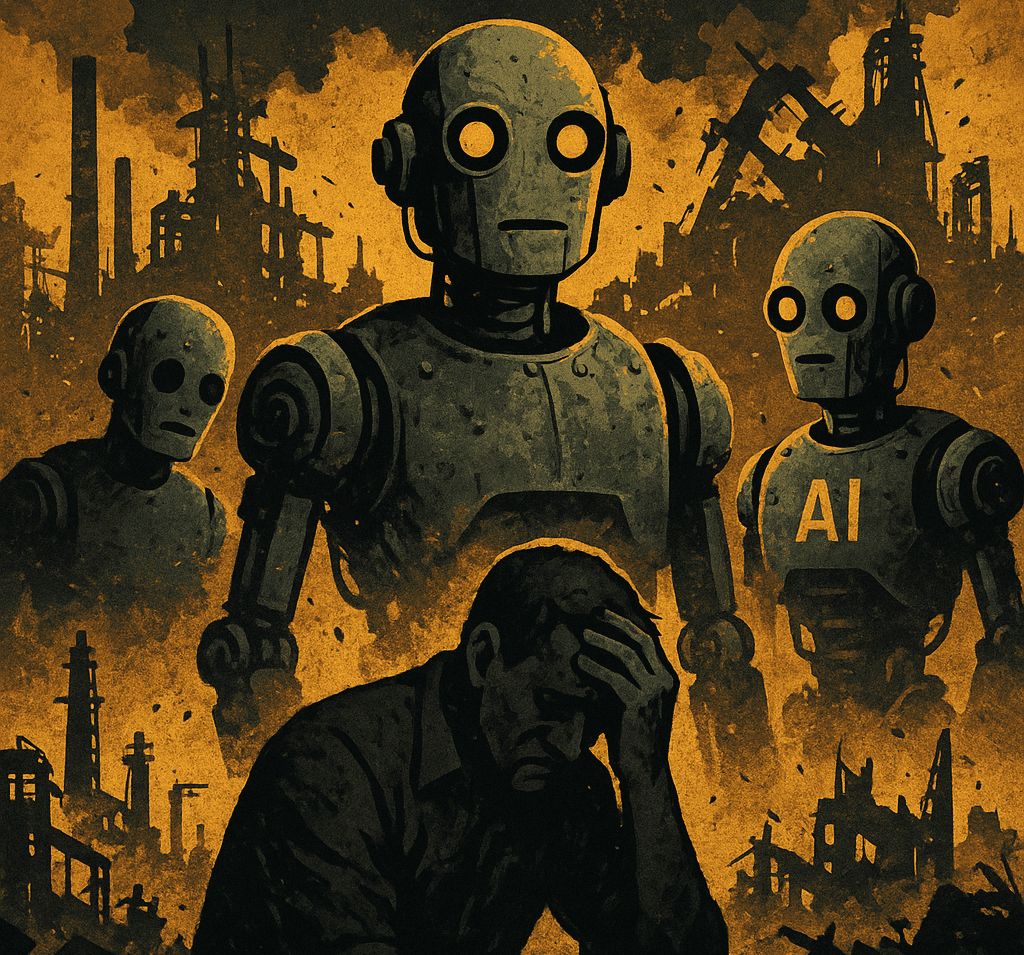
The Industrial Revolution reshaped the global economy, and the Digital Revolution pushed it further. But now, as automation and artificial intelligence (AI) replace human labor at an unprecedented pace, a paradox emerges: the more efficient production becomes, the less consumers can afford to buy. This post explores how the rapid advancement of AI and automation is accelerating economic collapse and what it means for the future of industry, commerce, and civilization itself.
Could a Post-Collapse Society Thrive Without Traditional Labor Markets?
As AI and automation continue to dominate production and service industries, the necessity of traditional labor markets diminishes. The question then arises: can society function in a world where human labor is no longer the primary driver of economic productivity? In a post-collapse scenario, where AI manages most aspects of production, logistics, and even governance, humans must redefine their role within the economic structure.
One potential path forward is the establishment of a resource-based economy, where automation meets all basic needs without the necessity for human employment. In this model, wealth distribution is decoupled from labor, and access to goods and services is based on need rather than purchasing power. However, transitioning to such a system requires overcoming major societal and ideological barriers, particularly in capitalist economies that are deeply rooted in work-based identity and meritocratic values.
Historically, societies that have attempted to break from traditional labor structures have struggled with inefficiencies and resistance from entrenched economic interests. The collapse of feudal economies during the Industrial Revolution serves as an example of how dramatic shifts in economic structures can lead to instability before new systems emerge. Similarly, an AI-dominated economy may require significant transitional policies, such as universal basic income or state-sponsored resource distribution, to prevent widespread social unrest during the shift away from traditional labor markets.
Ethical Questions About Human Purpose When Machines Do All Work
The rise of automation presents not only economic challenges but also profound existential dilemmas. If human labor is no longer required, what becomes of human purpose? The ethical implications of AI-driven economies extend beyond financial survival to psychological and philosophical concerns about meaning, motivation, and identity.
Throughout history, labor has played a central role in defining personal identity and social structure. Many people derive self-worth and purpose from their work, and the prospect of a world where jobs are obsolete raises concerns about widespread feelings of purposelessness and alienation. Studies on long-term unemployment have shown that a lack of work can lead to increased mental health issues, including depression and substance abuse. If automation renders human labor redundant, societies must find ways to redefine fulfillment and social contribution outside the traditional workplace.
One possible solution is the expansion of creative, intellectual, and leisure-based pursuits. With basic needs met by automation, humans could focus on education, artistic expression, scientific exploration, and other endeavors that have historically been limited by economic necessity. However, such a shift requires significant cultural adaptation, as societies conditioned to value work ethic and productivity must reframe success and self-worth outside of economic contributions.
Furthermore, ethical concerns arise regarding control and ownership of AI-driven resources. If a small number of corporations or governments control automation, the benefits of AI may be disproportionately distributed, creating an elite class with access to endless resources while the majority remain dependent on their goodwill. Ensuring equitable access to AI-generated wealth is critical to maintaining social stability and preventing the emergence of a neo-feudal system where power is concentrated in the hands of those who control AI-driven production.
Paths Toward a Sustainable Economic Future in an AI-Dominated World
Despite the potential for economic collapse, automation does not necessarily spell doom for humanity—if managed correctly, AI-driven production could lead to unprecedented prosperity and quality of life improvements. The key challenge lies in designing sustainable economic models that integrate automation without disenfranchising human populations.
One proposed model is universal basic income (UBI), in which every citizen receives a guaranteed income regardless of employment status. By decoupling financial security from labor, UBI could ensure that people can afford to participate in the economy even as traditional jobs disappear. Pilot programs in various countries, including Finland and Canada, have shown promising results, with recipients experiencing improved well-being and increased entrepreneurial activity. However, funding such programs on a large scale remains a significant challenge, particularly in economies currently reliant on taxation derived from employment income.
Another alternative is cooperative ownership of AI-driven enterprises, where profits generated by automation are redistributed to the public. This model aligns with historical examples of shared economic benefits, such as cooperative farming communities or worker-owned businesses. By ensuring that AI-driven wealth is collectively owned rather than monopolized, societies can create a more equitable distribution of resources.
Decentralized financial systems, including cryptocurrencies and blockchain-based governance models, also present potential solutions. By enabling direct peer-to-peer transactions and reducing reliance on centralized financial institutions, these technologies could facilitate more democratic economic participation. However, widespread adoption of decentralized systems requires overcoming regulatory resistance and technological barriers.
Additionally, sustainable post-collapse societies may rely on localized, self-sufficient communities that integrate AI technology into their resource management. Advances in 3D printing, automated agriculture, and decentralized energy production could enable small communities to operate independently of global supply chains. The rise of AI-driven smart cities and self-sustaining communes could mark a new phase in human civilization, where technological advancements are leveraged to create decentralized prosperity rather than concentrated wealth. Ultimately, the future of human value in an AI-driven economy depends on proactive policy-making and cultural adaptation. The collapse of traditional economic models presents an opportunity to redefine wealth, labor, and human purpose in ways that prioritize well-being over profit. Whether societies can successfully navigate this transition—or whether they will succumb to economic and social disintegration—remains one of the most pressing questions of the 21st century.
The Crossroads of Civilization We stand at the precipice of a new economic order—one where AI and automation can either liberate or impoverish humanity. The choices we make today will determine whether the collapse of industry and commerce leads to a dystopian wasteland or a reimagined future where human ingenuity finds new purpose beyond traditional labor.
The end of work does not have to mean the end of humanity. But without urgent, systemic change, it may spell the end of the economy as we know it.
Disclaimer: This post has been generated and/or enhanced with the assistance of artificial intelligence tools, using information available and believed to be current and accurate at the time of creation. However, the content may include speculative, interpretive, or subjective elements and does not necessarily reflect objective reality. The views and opinions expressed are solely those of the author and do not represent or imply the views of any employer, organization, or affiliated individuals. No endorsement, verification, or review by any such entities has been conducted or should be inferred.
