
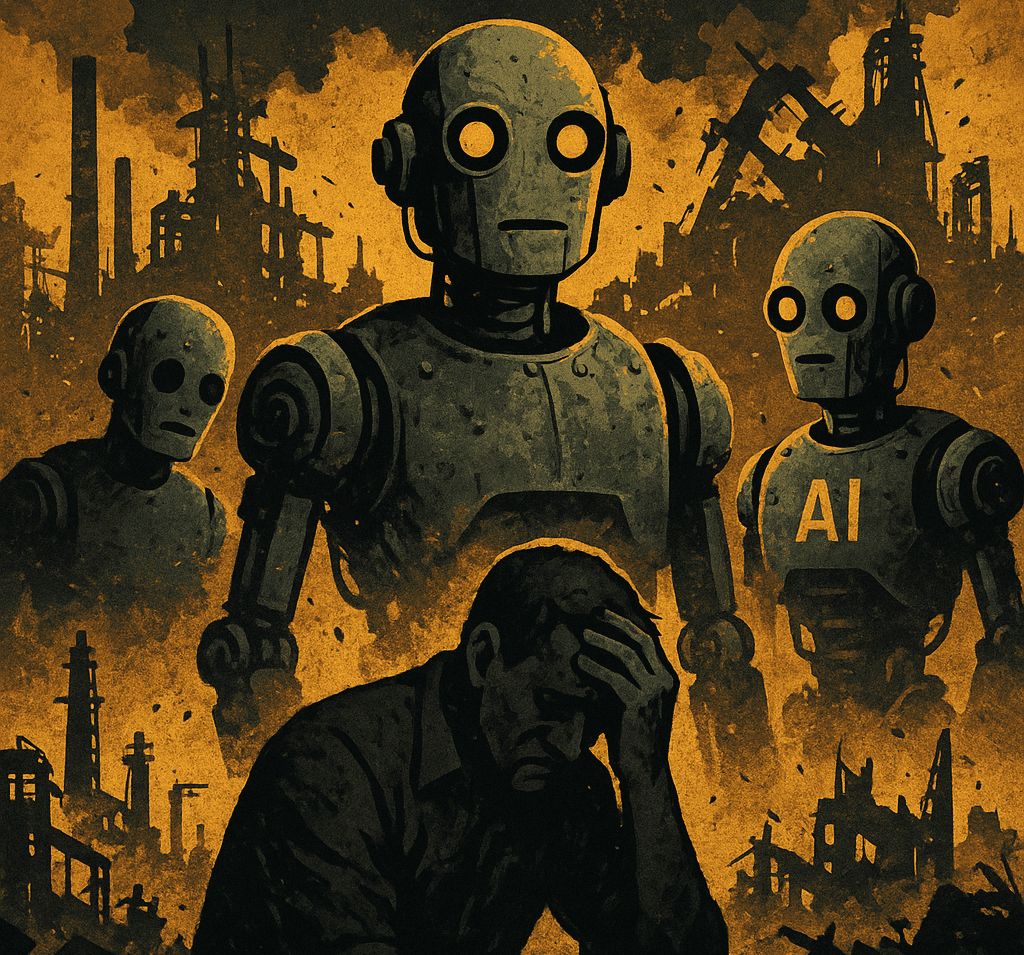
The Industrial Revolution reshaped the global economy, and the Digital Revolution pushed it further. But now, as automation and artificial intelligence (AI) replace human labor at an unprecedented pace, a paradox emerges: the more efficient production becomes, the less consumers can afford to buy. This post explores how the rapid advancement of AI and automation is accelerating economic collapse and what it means for the future of industry, commerce, and civilization itself.
Declining Profit Margins Due to Reduced Demand
As AI-driven automation takes over manufacturing, service industries, and logistics, companies find themselves facing an ironic dilemma: they can produce goods faster and cheaper, yet their customer base is shrinking due to widespread unemployment. Consumer spending is the lifeblood of industry and commerce, and when large segments of the population lose their purchasing power, even the most efficiently produced goods go unsold. This paradox is most visible in industries that rely on mass consumption, such as retail and automotive manufacturing.
For example, a fully automated factory can manufacture thousands of electric vehicles daily, but if only a small, wealthy fraction of the population can afford them, the industry collapses under its own overproduction. Companies attempt to combat this by cutting costs further, leading to a race to the bottom where only the largest conglomerates can survive. Small and medium-sized businesses that lack the resources to invest in full automation are the first casualties of this economic shift.
The Death of Small Businesses Unable to Compete with AI-Driven Efficiency
Small businesses have historically served as the backbone of economic resilience, driving competition, innovation, and employment. However, automation has tilted the playing field heavily in favor of large corporations with access to advanced AI-driven supply chains, logistics, and customer service. Small retailers, unable to match the efficiency of AI-optimized giants like Amazon, are disappearing at an alarming rate.
This phenomenon is particularly devastating in culturally diverse economies where small businesses often serve as community hubs. In regions with strong artisan traditions, such as Italy’s leather goods industry or India’s textile markets, automation threatens centuries-old craftsmanship. While global conglomerates can mass-produce synthetic alternatives at lower prices, local artisans cannot compete, leading to the erosion of cultural heritage alongside economic decline.
The Rise of Monopolies and the Decline of Free-Market Competition
Ironically, the rapid expansion of AI and automation—technologies hailed as innovations for economic growth—has led to market monopolization rather than diversity. Free-market economies thrive on competition, but when automation makes it nearly impossible for new businesses to enter the market, monopolies solidify their dominance.
For instance, the food industry has seen the rise of fully automated farming, processing, and distribution networks controlled by a handful of global corporations. While these companies benefit from reduced labor costs and increased efficiency, local farmers and independent grocers are crushed under the weight of AI-optimized supply chains that dictate prices and access to markets.
As monopolies gain control, consumers paradoxically lose choices despite the abundance of products. This homogenization of commerce stifles innovation, as risk-taking entrepreneurs find it increasingly difficult to compete against AI-driven conglomerates with vast resources and predictive analytics that eliminate market uncertainty.
Disclaimer: This post has been generated and/or enhanced with the assistance of artificial intelligence tools, using information available and believed to be current and accurate at the time of creation. However, the content may include speculative, interpretive, or subjective elements and does not necessarily reflect objective reality. The views and opinions expressed are solely those of the author and do not represent or imply the views of any employer, organization, or affiliated individuals. No endorsement, verification, or review by any such entities has been conducted or should be inferred.
