
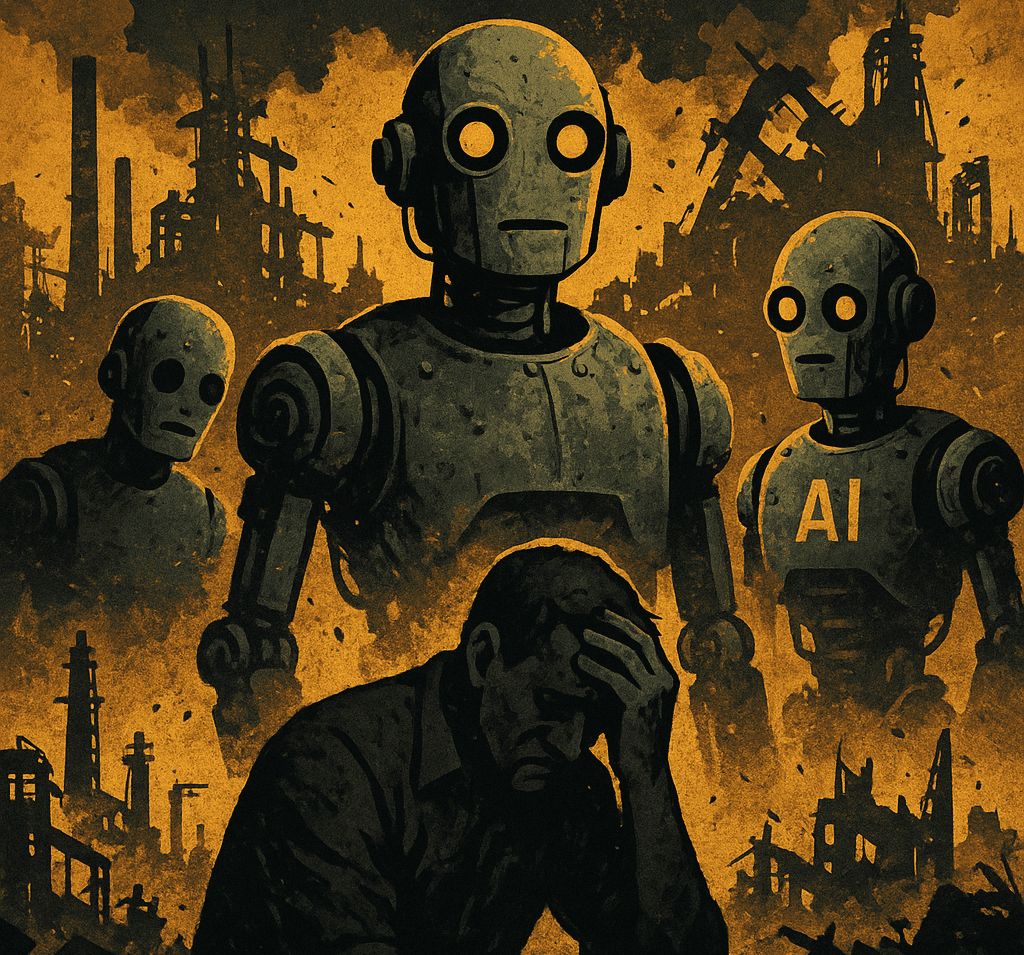
The Industrial Revolution reshaped the global economy, and the Digital Revolution pushed it further. But now, as automation and artificial intelligence (AI) replace human labor at an unprecedented pace, a paradox emerges: the more efficient production becomes, the less consumers can afford to buy. This post explores how the rapid advancement of AI and automation is accelerating economic collapse and what it means for the future of industry, commerce, and civilization itself.
The Growing Impact of AI on White-Collar Industries
While automation initially threatened blue-collar jobs in manufacturing and logistics, AI’s increasing capabilities are now targeting white-collar professions. Artificial intelligence, particularly through machine learning and natural language processing, is now capable of handling complex cognitive tasks that were once thought to require human expertise.
Industries such as finance, law, healthcare, and journalism are witnessing unprecedented changes. AI-powered legal software can now analyze contracts, draft legal documents, and even predict case outcomes more efficiently than human lawyers. In the financial sector, trading algorithms and robo-advisors manage investments with greater accuracy than human analysts. Even in creative fields, AI-generated content is challenging traditional roles in marketing, graphic design, and journalism.
Why Retraining Programs Fail to Keep Pace with Automation
Governments and corporations often propose retraining programs as a solution to automation-driven unemployment. However, these initiatives have consistently struggled to keep pace with the rapid evolution of AI and robotics. Several factors contribute to their ineffectiveness:
- Speed of Technological Change: The rate at which AI disrupts industries far exceeds the speed at which workers can be retrained. Many retraining programs prepare workers for jobs that themselves are at risk of being automated within a few years.
- Mismatch Between Skills and Industry Needs: Many displaced workers lack the foundational education needed for careers in technology-driven fields, making retraining efforts ineffective.
- Economic Barriers to Reskilling: Many workers cannot afford to take time off for education or training programs, especially those already facing financial instability.
- Limited Availability of Jobs Post-Retraining: Even when workers complete retraining programs, the number of available positions in high-tech industries is limited compared to the scale of job losses across other sectors.
The Creation of a Permanent Underclass
As AI automates more jobs, a significant portion of the population risks becoming structurally unemployed, unable to find work in an economy where human labor is no longer a necessity. This leads to the emergence of a permanent underclass—millions of people who are unable to participate meaningfully in the economy. The consequences of such large-scale unemployment are profound, leading to increased economic inequality, social unrest, and political instability. Governments face growing pressure to implement universal basic income (UBI) or other welfare measures to mitigate the effects of automation-driven job loss. However, without systemic economic restructuring, these measures serve only as temporary solutions to a much larger problem.
Disclaimer: This post has been generated and/or enhanced with the assistance of artificial intelligence tools, using information available and believed to be current and accurate at the time of creation. However, the content may include speculative, interpretive, or subjective elements and does not necessarily reflect objective reality. The views and opinions expressed are solely those of the author and do not represent or imply the views of any employer, organization, or affiliated individuals. No endorsement, verification, or review by any such entities has been conducted or should be inferred.
