
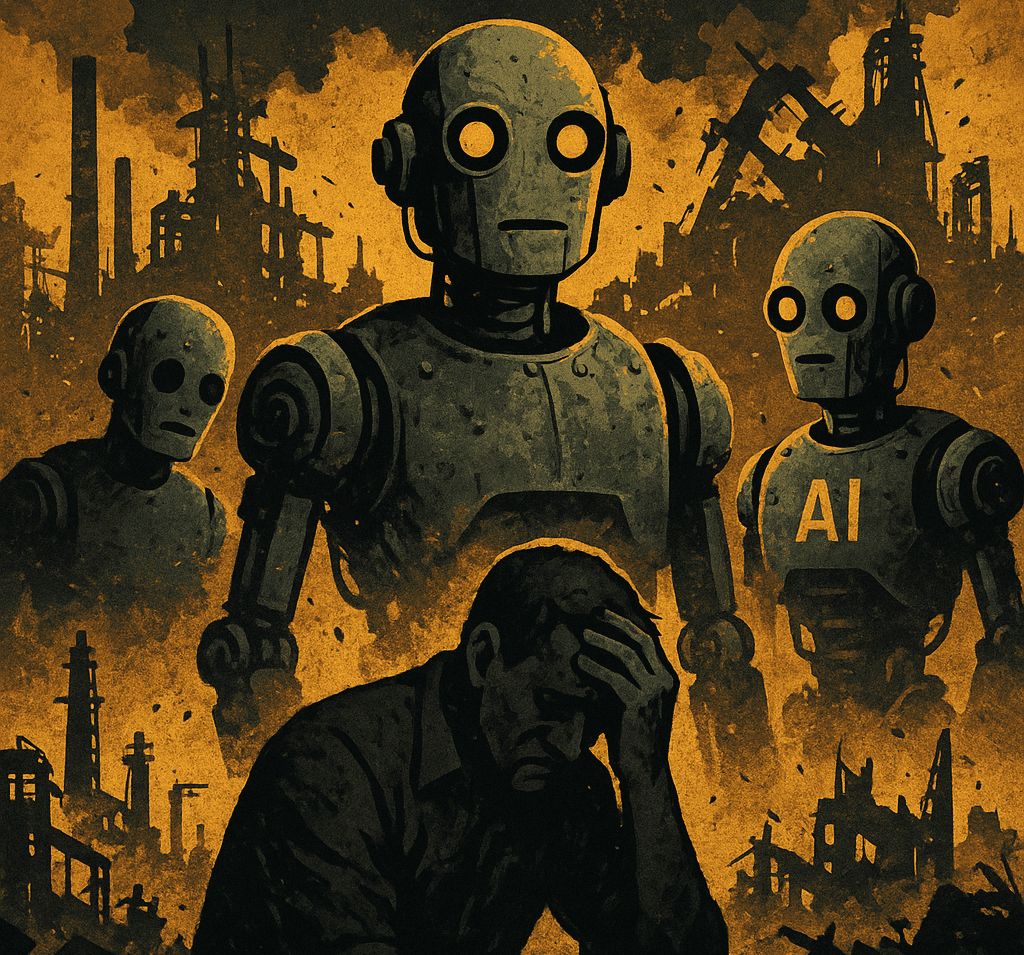
The Industrial Revolution reshaped the global economy, and the Digital Revolution pushed it further. But now, as automation and artificial intelligence (AI) replace human labor at an unprecedented pace, a paradox emerges: the more efficient production becomes, the less consumers can afford to buy. This post explores how the rapid advancement of AI and automation is accelerating economic collapse and what it means for the future of industry, commerce, and civilization itself.
The Shortcomings of Government Policy in Addressing Automation Displacement
Governments around the world have struggled to adapt to the rapid rise of automation and AI-driven economic shifts. While some policy initiatives have aimed at reskilling the workforce, implementing universal basic income (UBI), or regulating corporate monopolies, these efforts have largely fallen short. Bureaucratic inefficiencies, corporate lobbying, and political inertia have hindered meaningful legislative action. Governments that attempt intervention often do so too slowly or ineffectively, failing to anticipate the rapid changes in the labor market and economic structures.
Despite growing public concern over job losses and economic stagnation, many policymakers remain locked in outdated economic models that assume job creation will naturally follow technological advancements. However, as AI and automation replace not only blue-collar jobs but also white-collar and creative professions, the traditional notion of workforce adaptation becomes obsolete. The failure to implement proactive measures exacerbates wealth inequality, leading to mounting social and economic instability.
Intra-Governmental Conflicts: The Fragmentation of Decision-Making
As AI-driven automation disrupts industries at an unprecedented rate, governments face internal conflicts between different factions with competing interests. Some policymakers push for stronger regulations on automation and AI monopolies, while others advocate for free-market policies that favor corporate dominance. These internal divisions prevent the formation of coherent strategies to address economic displacement and social unrest.
Additionally, agencies tasked with economic regulation often operate in silos, leading to contradictory policies that stifle economic stability. For instance, one governmental body may push for worker protections and anti-monopoly regulations, while another, heavily influenced by corporate lobbying, promotes deregulation and tax incentives for AI-driven corporations. This disunity weakens the government’s ability to respond effectively to the economic crisis caused by automation.
Political parties further exacerbate these conflicts, using automation and economic distress as political leverage rather than working toward practical solutions. Instead of crafting forward-thinking policies, many governments engage in short-term, reactionary measures that fail to address the root causes of economic decline.
Extreme Polarization of Society and Its Impact on Policy-Making
As automation deepens wealth inequality and erodes job security, societal divisions grow more pronounced. Political polarization reaches extreme levels as different segments of the population blame opposing ideologies for the worsening economic crisis. Those who benefit from automation, such as tech elites and investors, support policies that further deregulate AI-driven industries, while displaced workers and economically struggling citizens demand stronger government intervention.
This ideological divide fosters social unrest, making it increasingly difficult for governments to pass meaningful reforms. The rise of populist movements on both the left and the right reflects public dissatisfaction with traditional political institutions. Left-wing factions advocate for universal basic income, wealth redistribution, and stricter corporate regulations, while right-wing movements push for nationalist economic policies, restrictions on automation, and protectionist trade measures.
As governments struggle to appease both sides, legislative gridlock becomes the norm. Instead of addressing the economic crisis, political leaders focus on appeasing their voter base through performative policies and rhetoric. This inability to act decisively exacerbates economic decline and further fractures society.
The Failure of Universal Basic Income and Other Safety Net Policies
One of the most widely discussed solutions to automation-induced job loss is Universal Basic Income (UBI). Proponents argue that providing a fixed income to all citizens would help maintain consumer demand despite declining employment opportunities. However, attempts to implement UBI have faced significant obstacles.
Critics argue that UBI is financially unsustainable, particularly as tax revenues decline due to widespread unemployment. Furthermore, corporate influence over policymakers has resulted in watered-down versions of UBI that fail to provide sufficient financial security. Instead of a robust safety net, governments often implement minimal cash handouts that fail to cover basic living expenses, forcing citizens to rely on unstable gig work and underpaid digital labor.
Other social safety net policies, such as expanded unemployment benefits and job retraining programs, have similarly fallen short. Retraining initiatives often fail to keep pace with automation, leaving displaced workers with outdated skills that no longer hold value in an AI-dominated economy. Meanwhile, unemployment benefits face cuts as governments struggle to balance budgets in the face of declining tax revenue.
The Risk of Authoritarian Responses to Economic Collapse
As economic instability worsens and civil unrest grows, governments face mounting pressure to maintain social order. In response, some administrations may resort to authoritarian measures, including increased surveillance, suppression of protests, and the criminalization of dissent. Under the guise of national security, governments may implement AI-driven monitoring systems to track and control public discourse, further entrenching corporate and political power.
The erosion of democratic norms in favor of corporate-backed authoritarianism poses a significant threat to civil liberties. Citizens facing economic hardship may be coerced into accepting restrictive policies that trade personal freedoms for financial stability. In extreme cases, governments may adopt draconian labor policies, forcing individuals into low-wage, state-mandated work programs to maintain basic sustenance.
The Role of International Conflict and Economic Fragmentation
The failure of national governments to address automation-driven economic collapse could also lead to international instability. Countries that successfully integrate AI into their economies may dominate global trade, while those struggling with mass unemployment and economic decline may fall into financial ruin. This disparity could lead to increased geopolitical tensions, trade wars, and resource conflicts. In addition, nations with failing economies may turn to protectionist policies, erecting trade barriers and restricting the flow of technology in an attempt to shield domestic industries. These measures, however, are likely to backfire, leading to further economic isolation and stagnation. As global supply chains collapse, international cooperation deteriorates, making coordinated economic recovery efforts nearly impossible.
The Urgent Need for Policy Overhaul
The failure of government intervention in the face of AI-driven automation highlights the urgent need for systemic reform. Without proactive policies that address wealth inequality, corporate monopolization, and social safety nets, economic collapse will accelerate, leading to widespread societal upheaval.
Governments must adopt forward-thinking strategies that prioritize long-term economic stability over short-term political gains. This includes implementing strong antitrust laws to prevent AI monopolies, redesigning education systems to prepare future generations for an automated world, and ensuring that economic policies reflect the changing nature of labor and production. However, without immediate and radical shifts in policy, the continued failure of governance in addressing automation’s impact may lead to irreversible consequences, including societal breakdown, political extremism, and global economic fragmentation.
Disclaimer: This post has been generated and/or enhanced with the assistance of artificial intelligence tools, using information available and believed to be current and accurate at the time of creation. However, the content may include speculative, interpretive, or subjective elements and does not necessarily reflect objective reality. The views and opinions expressed are solely those of the author and do not represent or imply the views of any employer, organization, or affiliated individuals. No endorsement, verification, or review by any such entities has been conducted or should be inferred.
