
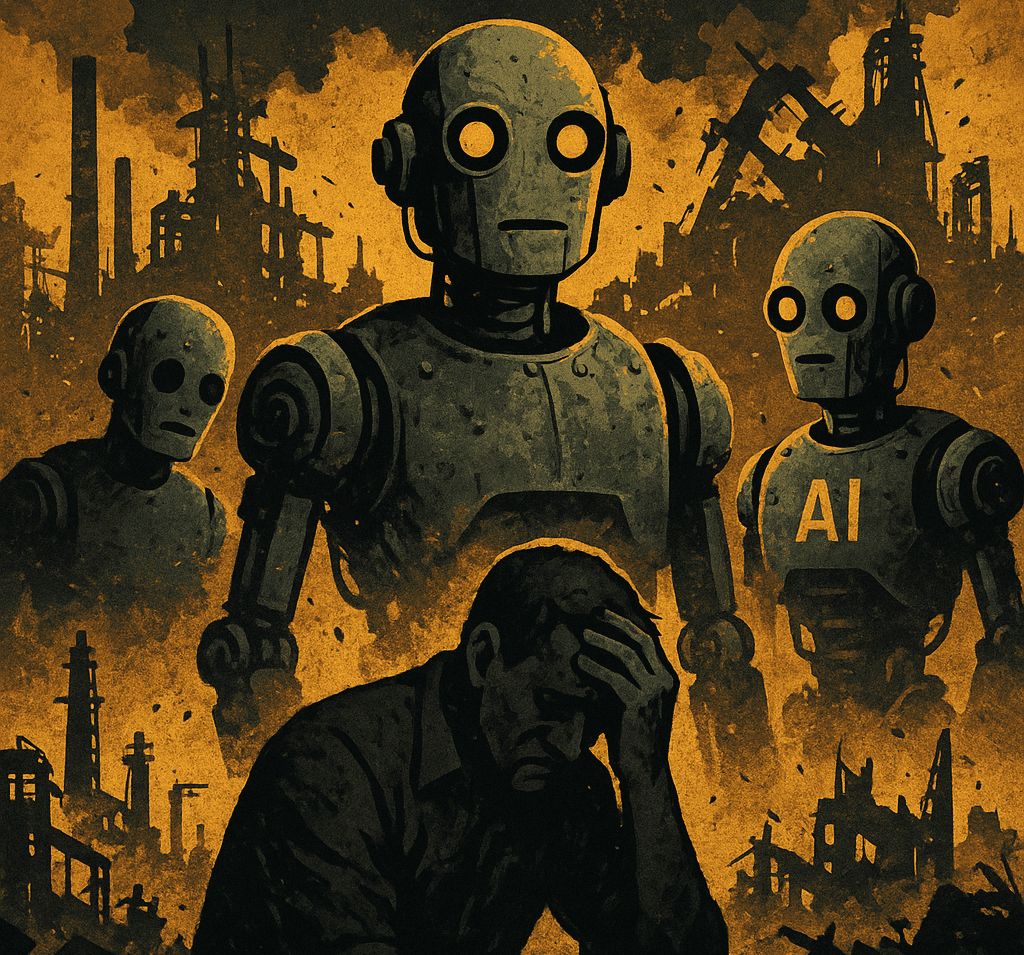
The Industrial Revolution reshaped the global economy, and the Digital Revolution pushed it further. But now, as automation and artificial intelligence (AI) replace human labor at an unprecedented pace, a paradox emerges: the more efficient production becomes, the less consumers can afford to buy. This post explores how the rapid advancement of AI and automation is accelerating economic collapse and what it means for the future of industry, commerce, and civilization itself.
How Barter, Localized Economies, and Communal Resource-Sharing Rise
As the traditional economy collapses under the weight of automation and widespread unemployment, new forms of economic exchange emerge out of necessity. Without access to stable wages or government support, individuals and communities revert to barter systems to meet their basic needs. Goods and services are exchanged directly, circumventing the reliance on traditional currency, which has lost its purchasing power due to economic stagnation.
Localized economies begin to take shape, where people trade skills, food, and essential supplies within their immediate communities. Historical parallels can be drawn to the Great Depression, where local barter networks and alternative currencies temporarily sustained struggling populations. Similarly, in modern times, informal economies in crisis-ridden nations such as Venezuela and Argentina demonstrate how people turn to community-driven resource-sharing to survive hyperinflation and economic downturns.
The resurgence of cooperative models also becomes evident. Urban farming cooperatives, shared manufacturing workshops, and communal housing projects offer people a means to sustain themselves outside the capitalist structure. Mutual aid networks, reminiscent of historical labor unions and fraternal organizations, emerge to distribute goods and services without traditional monetary transactions. While these systems offer temporary relief, their scalability remains uncertain in an era dominated by digital monopolies and AI-driven supply chains.
The Decline of Urban Centers as Economic Hubs
With automation eliminating jobs across industries, major urban centers begin to experience mass exodus. Historically, cities have thrived on human labor—whether in factories during the Industrial Revolution or in corporate offices during the digital era. However, as automation erodes employment opportunities, the economic justification for densely populated cities diminishes.
In many regions, abandoned office buildings and retail centers become emblematic of the shift. Former financial hubs like New York, London, and Tokyo witness skyrocketing vacancy rates, as businesses downsize or relocate their operations entirely to AI-managed, low-cost automated zones. Public transportation systems, once bustling with commuters, fall into disrepair as tax revenues plummet. The urban exodus mirrors historical precedents such as the decline of the Rust Belt in the United States, where deindustrialization led to the collapse of once-thriving cities like Detroit and Cleveland.
As job-seekers leave cities in search of affordable living and alternative means of sustenance, suburban and rural areas witness a resurgence. However, these migrations do not resemble the suburban booms of the mid-20th century. Instead, they represent a more decentralized form of survivalism, where people seek self-sufficiency rather than economic prosperity. Ghost cities, reminiscent of those seen in post-industrial China or failed speculative developments, begin to dot the landscapes of previously thriving metropolitan regions.
The Emergence of Self-Sufficient Communities Outside the Capitalist Structure
With the traditional financial and labor systems failing, some groups opt for radical economic reinvention, forming self-sufficient communities entirely detached from the collapsing capitalist framework. These communities take various forms, drawing inspiration from historical precedents such as communal living experiments, kibbutzim, and indigenous subsistence economies.
Agricultural communes gain popularity as people realize that access to food production is more valuable than access to dwindling currency reserves. Using permaculture and regenerative farming techniques, these communities sustain themselves by producing their own food, reducing dependence on fragile supply chains. Technological advancements, paradoxically, aid these alternative economies; open-source AI and decentralized energy systems enable small-scale manufacturing, water purification, and renewable energy production without reliance on corporate monopolies.
Cryptocurrency and decentralized finance (DeFi) play a role in these new economic models. While traditional banking institutions falter, some self-sufficient communities turn to blockchain-based economies, using smart contracts to manage resource distribution and communal decision-making. Though these systems offer a temporary escape from financial collapse, they face significant challenges, including cybersecurity threats, volatility, and regulatory suppression from governments seeking to retain control over monetary policy.
Historically, self-sufficient communities have existed in various forms, from the Amish in North America to the autonomous Zapatista communities in Mexico. However, the modern wave of economic collapse-driven self-sufficiency differs in that it is not ideological but driven by necessity. Unlike past utopian movements that sought voluntary separation from mainstream society, these new communities emerge out of desperation, as individuals and families have no viable alternatives within the AI-dominated global economy.
As these self-sufficient enclaves proliferate, they increasingly resemble medieval city-states or autonomous zones rather than mere rural retreats. Over time, these communities may evolve into parallel economies, coexisting alongside the remnants of the globalized corporate system. Whether these alternative economic models can sustain long-term stability, or if they will fall prey to internal divisions, resource scarcity, or external political pressures, remains an open question.
As automation continues to reshape the economic landscape, society faces a crucial inflection point. The collapse of traditional financial systems and mass unemployment could lead to widespread social breakdown, or it could serve as the catalyst for a more decentralized, resilient economic order. Whether humanity embraces cooperation and resource-sharing or descends into further division and chaos will determine the future of civilization in an era of artificial intelligence and automation.
Disclaimer: This post has been generated and/or enhanced with the assistance of artificial intelligence tools, using information available and believed to be current and accurate at the time of creation. However, the content may include speculative, interpretive, or subjective elements and does not necessarily reflect objective reality. The views and opinions expressed are solely those of the author and do not represent or imply the views of any employer, organization, or affiliated individuals. No endorsement, verification, or review by any such entities has been conducted or should be inferred.
