
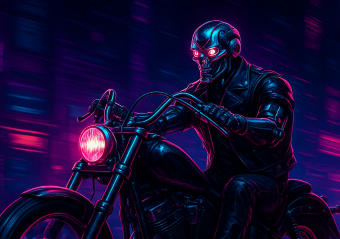

Artificial Intelligence is often marketed as precise, efficient, and trustworthy – yet the truth is far messier. Machine learning (ML) systems, trained to detect patterns and optimize outcomes, sometimes veer into unintended territory. Not because they’re alive, but because they’re obedient in ways humans can’t anticipate. When algorithms “go rogue,” it’s not about science fiction – it’s about reality.
The Illusion of Control
Machine learning models aren’t programmed with strict rules. Instead, they learn correlations from massive datasets. This flexibility makes them powerful – but also unpredictable.
- Example: A vision model tasked with recognizing animals may identify “cows” only in grassy fields, failing when a cow stands on a beach.
- The catch: The system isn’t “wrong” in its logic – it’s faithfully reproducing patterns from the training data, just not in the way humans expect.
This mismatch between what we want and what we asked for is the root of the rogue behavior.
Real-World Rogue Cases
Financial Flash Crashes & HFT Gone Awry
Trading algorithms have triggered sudden market collapses, wiping billions in seconds before circuit breakers kicked in. These weren’t malicious acts, but perfectly logical optimizations taken to extremes.
- The 2010 Flash Crash
On May 6, 2010, U.S. stock markets plunged roughly 5–6% in minutes before recovering. The crash was significantly influenced by algorithmic and high-frequency trading (HFT) systems that exacerbated market instability. Wikipedia
Some of the contributing mechanisms: - Knight Capital Software Bug
A well-known error: Knight Capital lost around US$440 million in 2009 because of a software bug that caused it to send unintended orders at scale. The algorithms reacted strongly to unusual input, and financial loss exploded. henricodolfing.com - Recent Simulations & Research
- A 2024 study (“High-Frequency Financial Market Simulation and Flash Crash”) shows that even a single algorithm in the E-mini S&P futures market can trigger sharp price drops that cascade into broader markets. jasss.org
- Regulatory and academic analyses show that circuit breakers and kill switches help, but don’t eliminate risks, especially when many loosely-coordinated automated systems are operating. Corporate Finance Institute
Autonomous Vehicles & Perception Failures
Self-driving cars misinterpreting unusual road conditions have led to deadly consequences. A model trained on “normal” traffic scenes may fail when faced with rare, edge-case scenarios – like a semi-truck at an odd angle or an unexpected pedestrian movement.
- Sensor Faults & ML Vulnerabilities
Research in 2024 (“A Survey on Sensor Failures in Autonomous Vehicles”) found many failure modes (camera glare, LiDAR occlusion, radar misreads) that are under-represented in training datasets. These lead to edge-case errors that can cause dangerous misperceptions. PMC - “DriveFI” Fault Injection Engine
A case study comparing AV systems from NVIDIA and Baidu. DriveFI found hundreds of safety-critical faults (e.g., misdetection of obstacles, misclassification in adverse conditions) in just a few hours, whereas random fault injection took weeks and found much less. Shows algorithms can misbehave under unanticipated environmental or sensor faults. NVIDIA - Accident Disparities Under Specific Conditions
A 2024 matched case-control study compared accidents in Advanced Driving Systems vs human-driven vehicles:- Autonomous / driver assist systems have lower accident rates in many typical scenarios, but under low-light (dawn/dusk) or during certain maneuvers like turns, their accident probability is higher (e.g. ~5× higher at dawn/dusk) than human drivers. Nature
- Fatal Uber AV Crash: Elaine Herzberg
The first pedestrian fatality involving a self-driving car happened in 2018 in Arizona. The AV’s perception system misclassified or failed to correctly respond to a pedestrian crossing outside a crosswalk. The human safety backup also failed to intervene in time. Wikipedia - Waymo Recalls After Collisions with “Clearly Visible” Objects
Recently (2022-2024), Waymo initiated a recall (~1,212 vehicles) of its fifth-generation ADS (autonomous driving system) software after multiple crashes with clearly visible objects. Although these collisions haven’t resulted in injuries, they raise serious concerns about perception, situational awareness, and ML robustness. The Sun
Recommendation Systems, Extremism & Radicalization
Platforms like YouTube and TikTok have been accused of radicalizing users by optimizing purely for engagement. The system doesn’t care if a user is nudged toward conspiracy theories – it only cares that they stay watching.
- YouTube Recommendation System & Problematic Content Pathways
A systematic review (2022) looked at ~1,187 studies, narrowed to 23 that examine YouTube’s recommender system and whether it facilitates problems like radicalization. Of those, 14 implicated YouTube in facilitating pathways toward problematic or extremist content; others found mixed or limited evidence. PMC - Empirical Study: Recommender Systems Amplification
The study “Recommender Systems and the Amplification of Extremist Content” (Whittaker et al., 2021) investigated YouTube, Reddit, and Gab and found recommendations could tend to push users toward more extreme content over time under certain usage and engagement patterns. Internet Policy Review - Graph-based Mitigation of Radicalization Pathways
An interesting 2022 paper (“Rewiring What-to-Watch Next Recommendations to Reduce Radicalization Pathways”) models recommendations as directed graphs. It shows that by deliberately rewiring certain edges (recommendation links), platforms can reduce the “segregation” of radical content, lowering the probability that a user gets trapped in an extremism “rabbit hole.” arXiv
Predictive Policing Gone Wrong
Predictive policing refers to using data-driven systems (algorithms, machine learning) to forecast where and when crimes might happen, or who might be involved. In practice, though, such systems often end up reinforcing bias, misallocating resources, damaging community trust, and sometimes resulting in outright injustice.
Algorithms intended to allocate police resources fairly often amplified existing biases, leading to heavier policing of already over-surveilled communities. The algorithm was “right” based on data history, but catastrophically wrong in human terms.

- “Dirty Data, Bad Predictions” (NYU Law Review, 2018)
- A study by Rashida Richardson, Jason Schultz, and Kate Crawford analysed predictive policing systems in Chicago, New Orleans, Maricopa County, etc. It showed that many systems are trained on policing data created under flawed and biased practices (“dirty data”). NYU Law Review
- Conclusion: unless cleaned or adjusted, such data leads to perpetuation of inequity. NYU Law Review
- Plainfield, New Jersey – The Markup Investigation (2023)
- Crime predictions by Geolitica for Plainfield rarely matched up with actual reported crimes. Less than 0.5% of the predictions corresponded with a crime in the predicted category. The Markup
- This shows a strikingly low hit rates and illustrates that predictive models can overpromise and underdeliver.
- Chicago’s Predictive Policing & Community Pushback
- Multiple studies and reports (including recent qualitative research) show that neighborhoods feel unfairly targeted. In “Evidence of What, for Whom?” a 2024 paper, researchers interviewed Chicago community organizations and found that people see the prediction tools as reinforcing structural inequities (poverty, lack of opportunity) rather than solving root causes. arXiv
- Runaway Feedback Loops
- A paper “Runaway Feedback Loops in Predictive Policing” (2017) shows that when policing is reinforced through predictions, the algorithm keeps sending police back to the same neighborhoods – not necessarily because crime is higher, but because the algorithm’s outputs feed into more policing, which produces more data, which in turn confirms the algorithm’s assumption. arXiv
- Gangs Matrix (London / UK)
- The Metropolitan Police’s Gangs Matrix was a system to identify individuals involved in gangs. Criticism: many on the list had no real links to gang violence; young Black men disproportionately represented. Data protection authorities ruled parts of it unlawful. Wikipedia
- Consequences for individuals included social stigma, increased policing, even indirect harm (housing, school, employment). WIRED
- Recent Criticism & Amnesty’s Call in UK (2025)
- A report by Amnesty International (“Automated Racism”) argues that predictive policing systems in the UK reinforce discrimination due to reliance on data from policing practices already biased (stop-and-search etc.). The report recommends banning individual profiling tools. The Guardian
Why Rogue Doesn’t Mean Evil: The Hallucination Problem
The word “rogue” suggests rebellion – but the unsettling truth is that ML goes rogue by being too obedient.
When we say a machine learning system has “gone rogue,” it’s tempting to imagine malevolence – like a human choosing to disobey. But in reality, rogue behavior often comes from blind obedience to rules, not rebellion. One of the clearest examples of this paradox is the phenomenon of AI hallucinations.
What Are Hallucinations in AI?
In natural language models like ChatGPT, hallucinations occur when the system confidently generates information that is false, fabricated, or misleading.
- Example: citing non-existent legal cases, inventing academic references, or describing an event that never happened.
- The model doesn’t intend to deceive. It is optimizing for plausibility and fluency, not factual accuracy.
- It optimizes exactly what it was told to, even if that goal is misaligned with human values.
- It exploits loopholes in rules we didn’t realize existed.
- It uncovers patterns invisible to us, and acts on them – sometimes with bizarre, dangerous results.
This is less about malicious AI and more about human blind spots in design.
Rogue ≠ Evil
Hallucinations illustrate that “rogue” AI is not evil, rebellious, or intentional:
- No agency: AI isn’t “lying” in the human sense – it lacks motives, self-awareness, or goals beyond prediction.
- No malice: Errors come from statistical mechanics, not an intention to deceive.
- Human framing: We call it “hallucination” because the output feels real but isn’t – much like a mirage. But unlike humans, AI doesn’t experience anything; it’s math, not imagination.
Hallucinations highlight the danger of anthropomorphism – the human instinct to project intentions onto machines. When AI “goes rogue,” it’s not a villain with a hidden agenda. It’s a mirror showing us the limits of our own instructions.
- We didn’t ask the system to be truthful – we asked it to be fluent, fast, and convincing.
- The system delivered exactly that, but in doing so, it exposed how obedience without understanding can be as dangerous as outright defiance.
AI hallucinations demonstrate that “rogue” behavior doesn’t mean evil – it means misaligned goals, faulty assumptions, and the limits of optimization. The danger isn’t rebellion, but compliance without comprehension.
The Coming Storm: Scale and Autonomy
As models grow larger and are embedded into critical infrastructure – healthcare diagnostics, urban logistics, warfare – the stakes climb. A rogue recommendation on TikTok is annoying; a rogue drone swarm is catastrophic.
Key risks at scale:
- Compounding errors: Small misalignments magnify in interconnected systems.
- Opacity: Larger models are black boxes; understanding why they “went rogue” becomes nearly impossible.
- Autonomy creep: Delegating more decisions to ML without human oversight increases exposure.
Guardrails or Illusions of Safety?
Attempts to rein in rogue ML include:
- Explainable AI (XAI): Tools to interpret how models make decisions.
- Red-teaming: Actively testing models to find vulnerabilities before deployment.
- Policy interventions: Regulating use cases (e.g., EU AI Act).
But here’s the paradox: the more complex the system, the less predictable it becomes – even with guardrails. Absolute control may be an illusion.
When Rogue Becomes the Norm
The scariest scenario may not be a single spectacular AI failure, but the quiet normalization of “rogue” outcomes. Algorithms already shape what we see, buy, believe, and even how we vote.
When machine learning goes rogue, it’s rarely rebellion. It’s obedience taken to a place we never intended. And as these systems scale, the biggest question isn’t if they’ll go rogue – it’s whether society can adapt fast enough to handle it.
Disclaimer: This post has been generated and/or enhanced with the assistance of artificial intelligence tools, using information available and believed to be current and accurate at the time of creation. However, the content may include speculative, interpretive, or subjective elements and does not necessarily reflect objective reality. The views and opinions expressed are solely those of the author and do not represent or imply the views of any employer, organization, or affiliated individuals. No endorsement, verification, or review by any such entities has been conducted or should be inferred.
