

Exploring the rise of generative tools, creative symbiosis, and the evolving role of the artist in the age of AI.
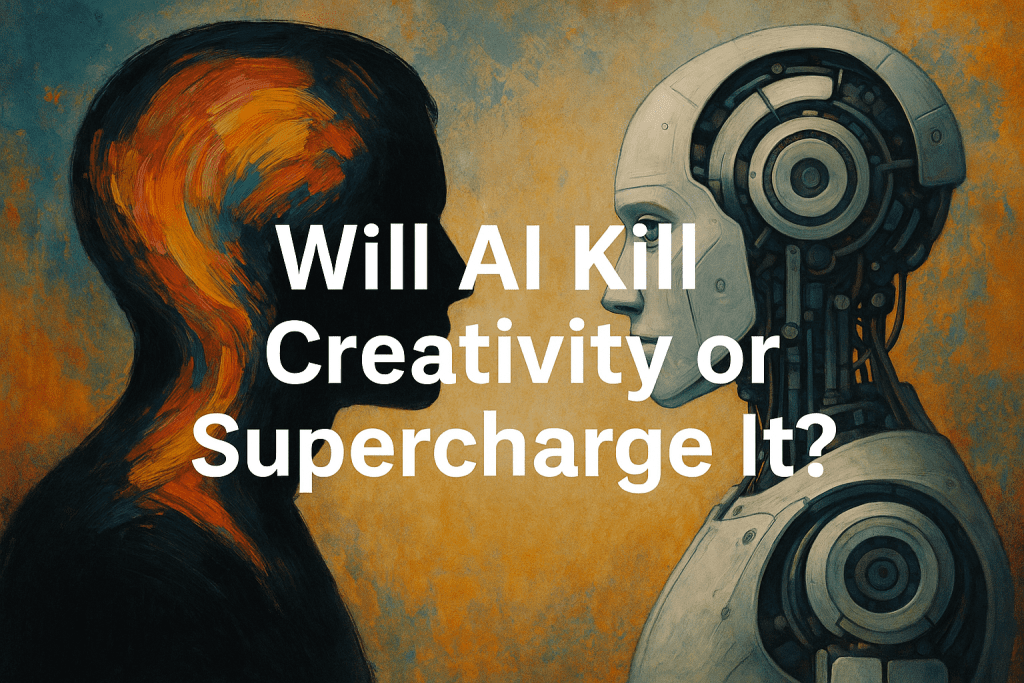
In recent years, AI has become a major force in creative industries—from writing and illustration to music, design, and now, even film. At the heart of this revolution is a pressing, almost existential question:
Will AI kill creativity or supercharge it?
For every jaw-dropping AI-generated artwork or deepfake video, there’s an undercurrent of anxiety: Will human creativity be displaced? Or are we entering a new era of amplified creative power?
Let’s dig deeper into this evolving conversation—especially around the fusion of human and machine creativity, and the arrival of sophisticated tools like Google Veo 3, which are transforming how stories are told on screen.
AI: A Threat to Originality, or Just Another Tool?
Some argue that AI threatens creativity by encouraging generic, mass-produced content. Since these models are trained on existing works, their outputs—while polished—can feel derivative. Others worry that by leaning on AI too heavily, we risk eroding our own creative muscles.
But history offers context. The printing press was feared for ruining oral storytelling. Photography was accused of killing painting. The synthesizer was once considered the death of music. In every case, the medium changed—but creativity endured. Often, it flourished.
AI is not inherently creative. It doesn’t feel. It doesn’t need to say something. It responds rather than initiates. That’s a critical distinction—and an opportunity.
Creative Symbiosis: The Artist + the Algorithm
At the center of the AI-creative revolution is a more interesting concept than replacement: symbiosis.
AI doesn’t need to be the artist. It can be the brush, the pen, the orchestra, or the film crew. When creators use AI intentionally—embedding it into their workflows—it can unlock ideas, accelerate execution, and extend imagination.
Here’s what that symbiosis can look like:
- Writers use AI to explore alternate story arcs, simulate conversations between characters, or restructure narratives in seconds.
- Visual artists sketch rough drafts and refine them using AI texture blending, lighting, or stylistic transformations.
- Musicians experiment with AI-generated harmonies or beats, using them as raw material to refine and remix.
- Filmmakers—and this is the newest frontier—can now turn scripts into realistic short films in minutes using tools like Google Veo 3.
Google Veo 3 and the Cinematic Leap
Video has traditionally been the most complex and expensive creative medium, requiring large teams, equipment, locations, and post-production workflows. That’s changing—fast.
Google Veo 3, the latest iteration of Google’s text-to-video model, is pushing the boundaries of what’s possible. It can generate high-quality, cinematic video clips directly from text prompts, sketches, or even storyboards.
What Makes Veo 3 Special?
- High Fidelity: Veo 3 offers 1080p resolution and fluid motion dynamics that rival traditional CG short films.
- Style Transfer: Users can apply specific cinematic styles—like Wes Anderson, noir, or anime—to transform mood and tone.
- Temporal Consistency: Earlier video models struggled to maintain coherence across frames. Veo 3 significantly improves continuity, making scenes feel more like films than GIF loops.
- Multimodal Input: Combine text with images, sketches, or video snippets to direct not just what the video shows, but how it feels.
This is no longer just stock footage generation. Veo 3 edges closer to being a collaborative filmmaking assistant—storyboard artist, effects team, and editor rolled into one.
Limitations Still Matter
As powerful as Veo 3 is, it’s not magic. The tool still has important constraints:
- Narrative Logic: While it can depict motion, Veo struggles with storytelling logic. Cause and effect, character consistency, and emotional nuance remain elusive.
- Character Control: Maintaining a character’s identity across multiple shots or scenes is still challenging. True narrative continuity remains a human-driven task.
- Bias and Ethics: Like all generative models, Veo inherits the biases of its training data. Representational accuracy, cultural sensitivity, and misuse potential remain key concerns.
- Lack of Intention: Veo doesn’t “mean” anything. It creates plausible visuals based on prompts—but it doesn’t understand subtext, symbolism, or metaphor unless directed by a human.
The Director Still Matters
Here’s the critical insight: The AI doesn’t replace the director—it becomes the crew.
Veo 3 can generate compelling visuals, but it needs human vision to tell a compelling story. The same is true for music, writing, and visual art. In the age of AI, what we create becomes less rare. But why we create—and how we guide these tools—is where human creativity still reigns.
This shift makes creative direction more important than ever.
Redefining Creativity in the AI Age
So, what does creativity mean now? It’s not just about originating something from scratch—it’s about curation, direction, manipulation, and transformation.
- You don’t need to shoot every frame—you need to shape the story.
- You don’t need to compose every note—you need to define the emotional arc.
- You don’t need to draw every pixel—you need to envision the world.
The myth of the solitary genius is being replaced by a new creative archetype: the AI conductor, the cyborg artist, the augmented storyteller.
Final Thought
AI will not kill creativity. But it will change who gets to be creative—and how.
The question is no longer “Can a machine be creative?” It’s “What can we do creatively now that machines are in the room?”
In the hands of curious, ethically-minded, and courageous creators, AI becomes not the end of originality—but the launchpad for a new creative frontier
Disclaimer: This post has been generated and/or enhanced with the assistance of artificial intelligence tools, using information available and believed to be current and accurate at the time of creation. However, the content may include speculative, interpretive, or subjective elements and does not necessarily reflect objective reality. The views and opinions expressed are solely those of the author and do not represent or imply the views of any employer, organization, or affiliated individuals. No endorsement, verification, or review by any such entities has been conducted or should be inferred.
