
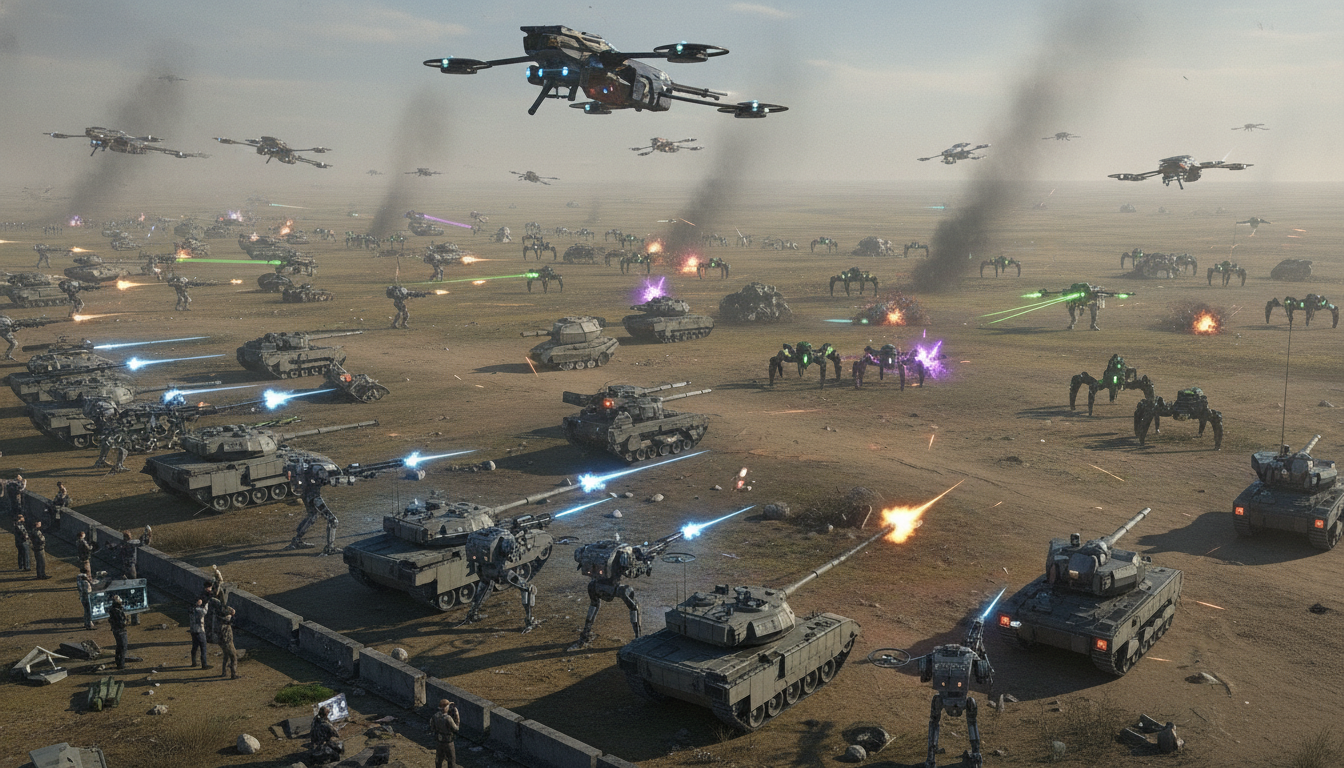
What if tomorrow’s battlefield is won not simply by firepower, but by whose machines “think” ahead, perceive context, adapt, and question — in some limited way — their own models of the conflict? That is the provocative promise (and peril) of cognitive computing in warfare.

In the military domain, cognitive computing might be used to help commanders discern emergent patterns on the battlefield, coordinate autonomous platforms, or anticipate adversary intent. But invoking “cognitive” immediately raises flags: what level of autonomy, oversight, and error tolerance are acceptable?
In this post I want to walk you through what I see as the key dimensions, tensions, and open questions of this evolving domain. Think of it as a conversation — sometimes cautious, sometimes assertive, always curious.
What does “cognitive computing” means?
- Cognitive computing refers broadly to systems that attempt to mimic or support human-like reasoning, perception, learning, adaptation, and context awareness (beyond simple rule-based or statistical automation).
- In practice, this might include adaptive decision-support systems, systems that fuse multi-modal sensor data and ‘reason’ over uncertain inputs, agents that re-plan dynamically, or even (in more speculative territory) systems that possess internal meta-models to question their own assumptions.
From Code to Carnage: How Close Are We to a “Terminator” Battlefield?
There’s a reason The Terminator remains one of the most cited cultural references in debates about AI and warfare.
Not because Skynet is real — but because the logic that gave birth to Skynet is already in motion.
The idea that autonomous systems might one day control the tempo of combat without human input no longer belongs to the realm of science fiction. It’s becoming a technical trajectory — slowly, quietly, and sometimes unintentionally — through the convergence of AI-driven cognition, autonomous robotics, and military decision-support systems.

Enabling trends and pressures
Explosion of data and sensing
Modern warfare increasingly generates overwhelming streams: ISR (intelligence, surveillance, reconnaissance) combines intelligence, open-source feeds, cyber or electronic warfare data, UAV feeds, satellite feeds, social media, etc. Humans alone cannot keep up. Systems that can triage, filter, cluster, and highlight anomalies become invaluable.
Advances in AI, ML, and compute
Deep learning, reinforcement learning, probabilistic modelling, and more efficient hardware (edge AI, neuromorphic chips) enable systems closer to “cognitive.” What was once science fiction (contextual fusion of modalities, real-time adaptation) is creeping in labs and prototypes.
Operational speed and decision tempo
In many settings — e.g. air defense, cyber warfare, rapid maneuvers — decisions must be made faster than human cycles allow. Cognitive systems, in principle, can help precompute scenarios, flag options, or even act semi-autonomously.
Asymmetric pressure & cost constraints
Smaller powers or non-state actors may not match big militaries in quantity of assets; but cognitive augmentation could shift the calculus. Similarly, military planners see efficiency gains (fewer humans, more autonomous coordination) as attractive.
Given these trends, the question is not “if,” but “how — and how safely.”
The promises and a tightrope
Decision-support for commanders
Systems digest thousands of reports, sensor feeds, historical records, adversary doctrine, and suggest courses of action, highlighting trade-offs.
However, garbage in, garbage out: erroneous models or biases could mislead decision-making. Overreliance might dull human judgment.
Autonomous platform coordination
Drones, robotic ground vehicles, or unmanned naval assets can work together, reshuffling tasks dynamically as conditions shift.
Nevertheless, miscommunication, emergent unwanted behavior, cascading failures brings to attention: Who’s in control?
Predictive/adversary intent modeling
Systems attempt to “read the mind” of the adversary—pattern-match signaling, deception, movement, communications.
One must never forget: Predictive models are probabilistic; adversaries may deliberately feed false signals. Misleading predictions could become self-fulfilling errors.
Cognitive electronic/cyber warfare
Systems that can adapt jamming strategies, reconfigure cyber payloads, or detect intrusions in real time with context awareness seem like the cherry on the top.
But complexity, unintended escalation, misattribution and vulnerabilities to adversarial ML attacks may prove to be an Achilles Heel.
One faulty inference, one miscoordination, could have strategic consequences.
The cautious side: key risks and constraints
Trust, interpretability, and human oversight
A cognitive system may produce a recommendation or decision, but can humans always understand why? In a high-stakes situation, opaque “black box” reasoning is a liability. Commanders must retain meaningful oversight. If a system “thinks” in a way we can’t audit or correct, we risk catastrophic surprises.
Bias, learning pathologies, and adversarial subversion
Machine learning systems can inherit biases from their training data – or develop pathological behaviors when pushed outside training regimes. In contested warfare, adversaries may deliberately feed adversarial inputs or poison intelligence feeds. A cognitive system might latch onto spurious correlations, over-trust false signals, or misinterpret deception as truth.
Unpredictability and emergent behavior
One of the appeals of complex cognitive systems is that they might surprise us with creative strategies. But surprise can cut both ways – uncontrolled emergent behavior could produce unanticipated, dangerous moves. The more “cognitive” the system becomes, the less fully predictable it is.
Arms race and escalation
Deploying cognitive warfare tools invites adversaries to match or exceed them, perhaps with counter-cognitive systems (jamming, deception, adversarial machine learning). There is a risk of escalation into a new arms race of autonomous “brains vs. brains.” Further, miscalculation where one side misreads the other’s system’s intent, might trigger unintended conflict.
Ethical, legal, and accountability gaps
Who is responsible when a system misfires – the operator? The software developer? The chain of command? International humanitarian law (IHL) demands principles like distinction, proportionality, and accountability. Embedding “cognitive” systems into lethal decision loops strains these legal and ethical frameworks. Some scholars argue that fully autonomous lethal systems should be prohibited or tightly regulated. (See, e.g., concerns around “killer robots” and the Campaign to Stop Killer Robots.)
Resource constraints, fragility, and infrastructure risk
These systems may require large computing capabilities, stable communication, access to power, and robust sensors. In degraded or contested environments (jamming, denial-of-service, stealth settings), their performance may degrade – perhaps catastrophically – more than human systems.
Assertive caveats and guardrails
“Human in the loop (HITL) or on the loop (HOTL)” as default
Decisions that lead to irreversible outcomes (especially lethal force) should either demand human approval or allow human override. Let the system propose but let the human confirm. In less critical domains (e.g. logistics, sensor fusion), greater autonomy may be tolerable.
Transparent reasoning and audit trails
Every decision or suggestion made by a cognitive system should come with justifications, confidence levels, and a log of influencing factors. If a commander or oversight body wants to “drill into” the reasoning, that must be possible.
Adversarial robustness, red-teaming, and “cognitive safety engineering”
Systems must be tested against adversarial inputs, deception, sensor spoofing, and edge-case scenarios. Robustness needs to be designed in from the start, not tacked on.
Layered fail-safe fallbacks
If the cognitive system produces uncertainty or conflict, fallback to a more conservative, simpler mode (or human-only mode) must be possible. Do not let the system “go dark” when conditions deteriorate; allow graceful degradation.
Incremental deployment, not sweeping leaps
A low-risk, supportive roles (e.g. sensor data filters, logistic planning, battlefield situational awareness) must be solidly deployed before entrusting systems with command or control in high-stakes domains.
International norms, verification, and oversight
Like nuclear arms or chemical weapons, perhaps cognitive warfare tools should be subject to international treaties, audits, or transparency regimes. Verification (how do you detect whose systems are cognitive-enabled?) will be a thorny challenge.
Ethics-first design and multi-disciplinary governance
Engineers, ethicists, legal scholars, military leaders, civil society must co-design systems. Before field deployment, we must consider “what could go catastrophically wrong?”
Situational attention: walking through a hypothetical scenario
This fictional scenario (but grounded in realism) could demonstrate the kinds of tensions and contradictions that may happen:
The scenario
A border region is tense. Country A suspects of an incursion by Country B’s forces. A has deployed cognitive-support systems at several forward outposts. These systems analyze radar, drone feeds, human intel, SATCOM signals, etc.
One of the cognitive subsystems flags an anomalous cluster of small UAVs flying low along a ridge. It correlates this with recent discreet satellite movements of supply trucks and signals traffic in adjacent valleys. The subsystem proposes two courses:
- Option 1: Preemptive interdiction – send a strike to disrupt the UAV cluster before they cross the border.
- Option 2: Continue observing, reposition sensors, increase patrols, await further confirmation.
The system gives confidence levels: Option 1 has 65 % confidence in this being the correct course of action; Option 2 holds at 54 %. It also shows that if it is wrong and strikes erroneously, escalation risk is high.
A human commander must now choose. She can drill into the logic: “What sensor strongly contributed? Did the system consider possible decoys? What if adversary deliberately fed a false trail?” She requests further simulation from the system (which runs dozens of counter-models) and sees that some adversary deception models could invert the threat. She opts for Option 2.
Later, it turns out the anomaly was a probing drone cluster – possibly dangerous, but not yet an actual incursion. The delay bought time but also allowed the adversary to reposition elsewhere. The cognitive system gets feedback and updates its model.
In that small vignette, many tensions were active:
- The system offered bold proposals – but the human had to resist overconfidence in them.
- The human used meta-skepticism: “What if deception?”
- The system’s model is not perfect – it must remain revisable, transparent, and subject to contestation.
- The power lies not solely in correct predictions, but in how you manage uncertainty, dissent, and adversarial methods.
This is situational attention – staying attuned to the specific conditions, blind spots, stakes, and feedback loops – not assuming that a cognitive system is magically “smarter” by default.
What are some of the contention points?
Cognitive computing will decisively tip future wars
Perhaps not. Adversaries will counter with AI-hardened defenses, jamming, deception, “dumb but reliable” fallback systems. In many domains, human judgment and context will remain decisive.
We can build sufficiently safe, predictable cognitive systems
Skeptics (in many areas) argue that “you cannot fully predict a system more complex than your capacity to test it.” Some hold that for lethal decisions, autonomy must be limited.
International norms by treaty are feasible
Hard in practice: States may hide capabilities, classify developments, or use dual-use AI for civilian/military. Verification is very tough. Even if agreed to some legal framework, States can withdraw, this has happened before.
Adversarial AI risk is manageable
As we push cognitive systems, adversarial attacks, poisoning, deception become existential risks themselves. A wrong trick might cascade.
Ethics and law will keep pace
History is skeptical: law often lags technology. It is very likely that AI use in warfare outpaces our normative frameworks.
In short: I assert that cognitive computing offers powerful levers, but those levers are double-edged. We must proceed with humility and structure.
Are we going to see The Terminator any time soon on our battlefields?
Are we going to see The Terminator any time soon on our battlefields?
We are not yet at a point of sentient war-bots or “thinking machines” in full control of battlefields. But the seeds are being planted now in labs, testbeds, and niche deployments.
A major risk is gradualism: we may slide into high autonomy by incremental steps without fully pausing to reflect on consequences.
The “cognitive gap” will not be purely technical. It will be social, institutional, and philosophical. How do human and machine “cognitive spaces” interlock? Who gets to contest the machine’s reasoning?
The direction we take – whether reckless or constrained – will define decades of warfare, deterrence, and international order.
Disclaimer: This post has been generated and/or enhanced with the assistance of artificial intelligence tools, using information available and believed to be current and accurate at the time of creation. However, the content may include speculative, interpretive, or subjective elements and does not necessarily reflect objective reality. The views and opinions expressed are solely those of the author and do not represent or imply the views of any employer, organization, or affiliated individuals. No endorsement, verification, or review by any such entities has been conducted or should be inferred.
