
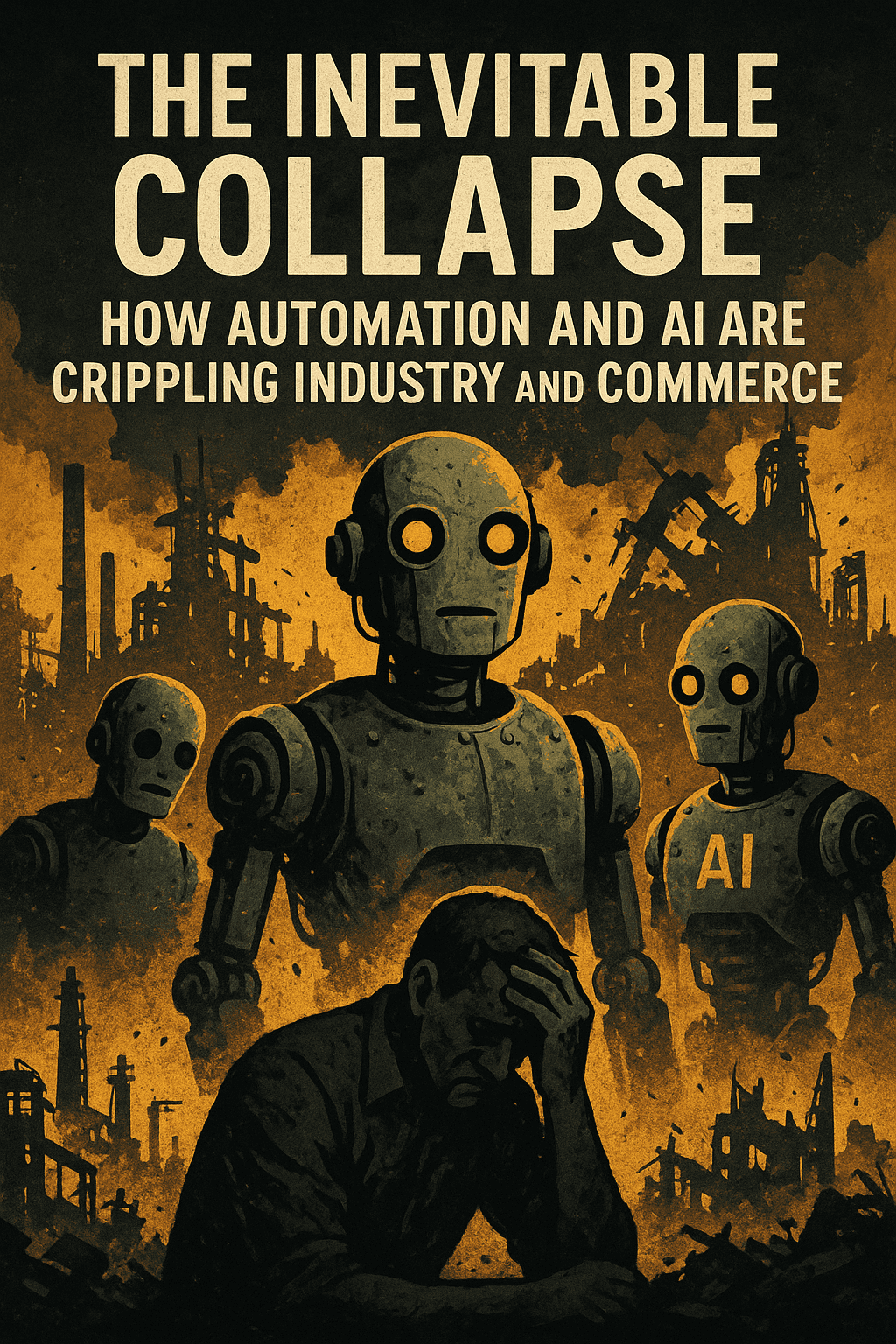
The Industrial Revolution reshaped the global economy, and the Digital Revolution pushed it further. But now, as automation and artificial intelligence (AI) replace human labor at an unprecedented pace, a paradox emerges: the more efficient production becomes, the less consumers can afford to buy. This 10 chapter post explores how the rapid advancement of AI and automation is accelerating economic collapse and what it means for the future of industry, commerce, and civilization itself.
Timeline of Decline and Collapse:
- 2020-2025: AI and robotics improve efficiency in logistics, retail, and manufacturing, leading to significant job displacement.
- 2026-2030: Mass layoffs result in declining wages and reduced consumer spending; basic universal income experiments begin.
- 2031-2040: Small and medium-sized businesses struggle as AI-driven monopolies dominate markets, leading to further unemployment.
- 2041-2050: Governments fail to adapt to the economic reality; financial institutions collapse due to unsustainable debt and deflationary pressures.
- 2051 and beyond: Global commerce becomes unsustainable as demand collapses; alternative economies and barter systems emerge.
Chapter 1: The Economic Paradox of AI and Automation
- How technological advancements increase productivity but reduce consumer purchasing power.
- Historical parallels with the Industrial Revolution and the Great Depression.
- The shift from a labor-driven economy to capital-intensive automation.
Chapter 2: The Microeconomic Effects on Industry and Commerce
- Declining profit margins due to reduced demand.
- The death of small businesses unable to compete with AI-driven efficiency.
- The rise of monopolies and the decline of free-market competition.
Chapter 3: Macroeconomic Trends Leading to Collapse
- The disappearance of the middle class.
- Deflationary spirals as automation reduces wages and demand.
- The inability of monetary policies to counteract job loss-driven stagnation.
Chapter 4: The Role of AI in Labor Market Disruptions
- Automation’s impact on blue-collar jobs.
- AI-driven displacement in white-collar industries.
- Why retraining programs fail to keep pace with automation.
Chapter 5: The Consumer Crisis: Affordability vs. Abundance
- The paradox of plenty: goods become cheaper, but incomes shrink.
- The transition from consumer-driven to AI-driven economies.
- Psychological and social consequences of mass unemployment.
Chapter 6: Corporate Consolidation and Market Monopolization
- The dangers of corporate-political alliances.
- Civil Unrest and the Dissociation of Government from Citizens
- How a handful of AI-driven corporations control the global economy.
- The death of competition in tech, retail, and manufacturing.
Chapter 7: Government Intervention and the Failure of Policy
- The pitfalls of universal basic income and wealth redistribution.
- Why taxation on automation and AI fails to curb economic decline.
- The inability of governments to legislate against technology-driven unemployment.
Chapter 8: The Death of Traditional Financial Systems
- The collapse of consumer banking as spending diminishes.
- The failure of stock markets reliant on economic growth.
- How cryptocurrency and decentralized finance emerge in response.
Chapter 9: Societal Breakdown and Alternative Economic Models
- How barter, localized economies, and communal resource-sharing rise.
- The decline of urban centers as economic hubs.
- The emergence of self-sufficient communities outside the capitalist structure.
Chapter 10: The Future of Human Value in an AI-Driven Economy
- Could a post-collapse society thrive without traditional labor markets?
- Ethical questions about human purpose when machines do all work.
- Paths toward a sustainable economic future in an AI-dominated world.
Disclaimer: This post has been generated and/or enhanced with the assistance of artificial intelligence tools, using information available and believed to be current and accurate at the time of creation. However, the content may include speculative, interpretive, or subjective elements and does not necessarily reflect objective reality. The views and opinions expressed are solely those of the author and do not represent or imply the views of any employer, organization, or affiliated individuals. No endorsement, verification, or review by any such entities has been conducted or should be inferred.
